Hello, sorry for the long period of time since my last blog update - I intend to make up for it by writing a couple more in-depth reviews over the next couple of days. But firstly, I thought I'd kick things off with a few words about the new watches of Basel 2010, now that they've had chance to reach reality.
I thought it was a slightly poor showing from Omega this year, nothing to really excite the senses, despite a raft of new models. We had yet another limited edition Speedmaster Professional, this time to commemorate the Apollo-Soyuz linkup. The main talking point is its Meteorite dial - a nice idea in theory, but in reality, it falls flat. The problem is, the Meteorite is too dark, and lacks the play of light that Rolex's Meteorite dials have, for example. If anything, it just makes it look as if the crystal has been scratched up. Then we have the price - at a smidge over £5000, you're looking at a £3000 premium over the standard model. Sure, you get a fancy box, but I can't see how it can be over double the price of the standard model, just because of the dial. In my opinion, Limited Edition Omegas being churned out every year is just damaging the collectibility of them, and surely that's what it's all about?
They also introduced a white version of the Plo Prof - not my cup of tea, but I think it may have a niche following. The only downside is that it is going to date horribly - I reckon this one will only stay in the range for 2 or 3 years at max. A new Double Eagle multi-counter chronograph has been launched (same movement as in the Olympic multi-counter chrono that came out a couple of years ago), which gives a very sporty look to the traditionally dressy Constellation line. However, I think with the black contrast bezel, crown and pushers, it looks too much like a TAG F1 for my liking. Plus, it's another chronograph in an already overcrowded range - I don't think it's going to have much of a following. The introduction of an Aqua Terra Annual Calendar is a nice idea, and gives a slightly more useful every day design option compared to the Hour Vision Annual Calendar, but I reckon the price might be prohibitive. Time will tell with that
Rolex's two big model revisions this year were the long-awaited introduction of the ceramic Submariner, both in black and green, and the much needed touch-up of the Explorer. Both subscribe to Rolex's new cutting-edge design ethos, and look brilliant in the flesh. The new Submariner is streets ahead of any other diver on the market (despite what some Planet Ocean LiquidMetal fanboys may say), and is a great example of what a modern sports watch should be. The Explorer has its own niche by being 39mm (sitting between the 36mm case diameter of the old Explorer, and the 41mm of the Milgauss), has a rather nice new matte dial, and, of course, a heavily revised bracelet. There has been some discontent over the size of the hands, but in reality, it really isn't an issue. I was very impressed by both of these models, in depth reviews will follow.
From other brands, the stand out for me was Breitling: they've launched a great looking and very affordable new SuperOcean. I love the choice of contrast colour chapter rings available, and the amount of performance for the price is very tempting. This could well eat into the market of the Omega SMP and the TAG Aquaracer.
There were, of course, plenty of other brands launching, but I feel these were the most worthy of commenting on. Hope you enjoyed the read, and stay tuned for more reviews!
Showing posts with label Rolex. Show all posts
Showing posts with label Rolex. Show all posts
Tuesday, 16 November 2010

Saturday, 1 May 2010
Rolex GMT-Master II 16710 Review
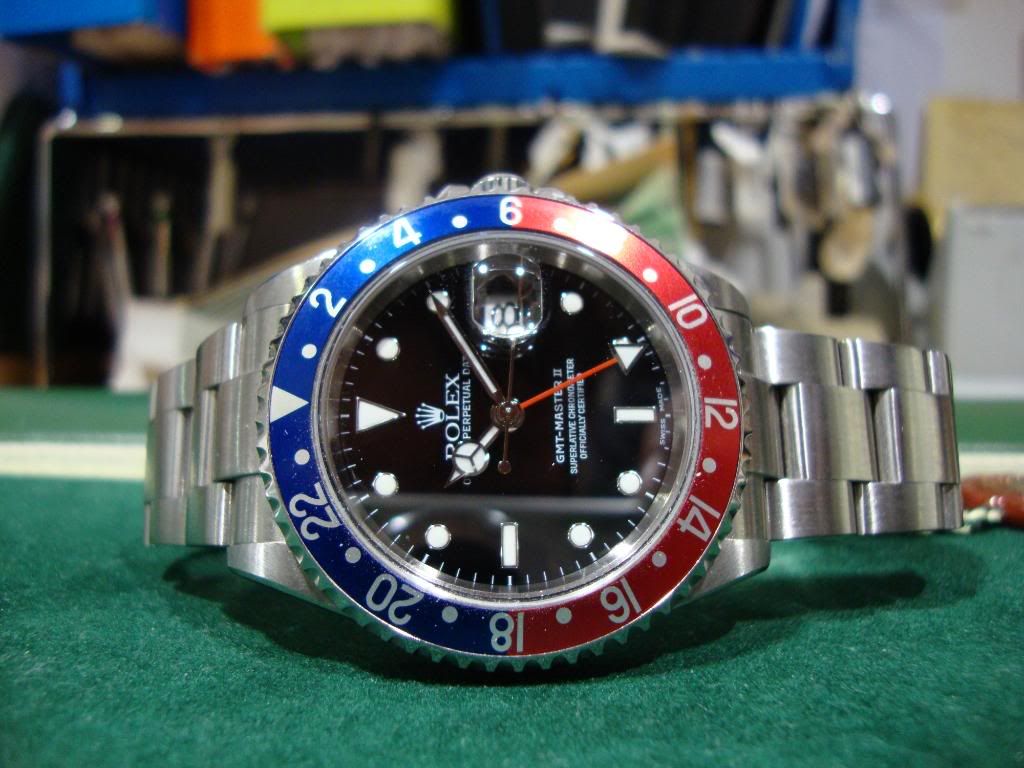
It's been a long time coming, but here's a new blog post! Time for a new review, and it's a horological legend: the GMT Master II 16710, a long time stalwart of the Rolex range until it was killed off in favour of the new 116710 GMT IIc. The GMT has always been a fan favourite, and, having a pristine example to hand, thought it was time to review this truly beautiful watch. The model reviewed had the "Pepsi" red and blue bezel fitted, and was on the Oyster bracelet, with sports clasp.

Technical Features
*Model ref. 16710
*Stainless steel case
*Bidirectional 24hr bezel, with choice of blue/red, red/black and black anodised aluminium inserts
*Case Diameter: 40mm
*Black sports dial with luminous (Superluminova) dot and baton markers w/ white gold surrounds
*Twinlock crown with crown guards
*Sapphire crystal with cyclops-magnified date
*24 hr. hand
*Independent hour hand - allows up to three time zones to be displayed concurrently
*Oyster Bracelet
The Movement
*Calibre 3185
*28.8k BPH
*Approx. 48 hour power reserve
*Self winding chronometer rated movement
*Semi-quickset date (done through independent hour hand)
*Nivarox hairspring
UK RRP: Discontinued. 2nd hand value of model posted: £2950.
The Aesthetics
That blue and red bezel combination makes this one of the most easily recognised Rolex models out there - it just screams "GMT." This might be too colourful for some, but I personally love it - practical, and iconic. If blue and red is too much, the other bezel inserts would certainly make it more understated. The numerals on the bezel are a little more subtle than on the GMT IIc, and I think it generally helps make the watch seem more rough and ready - a bona fide tool watch, as opposed to the "useful dress watch" appearance of the GMT IIc.
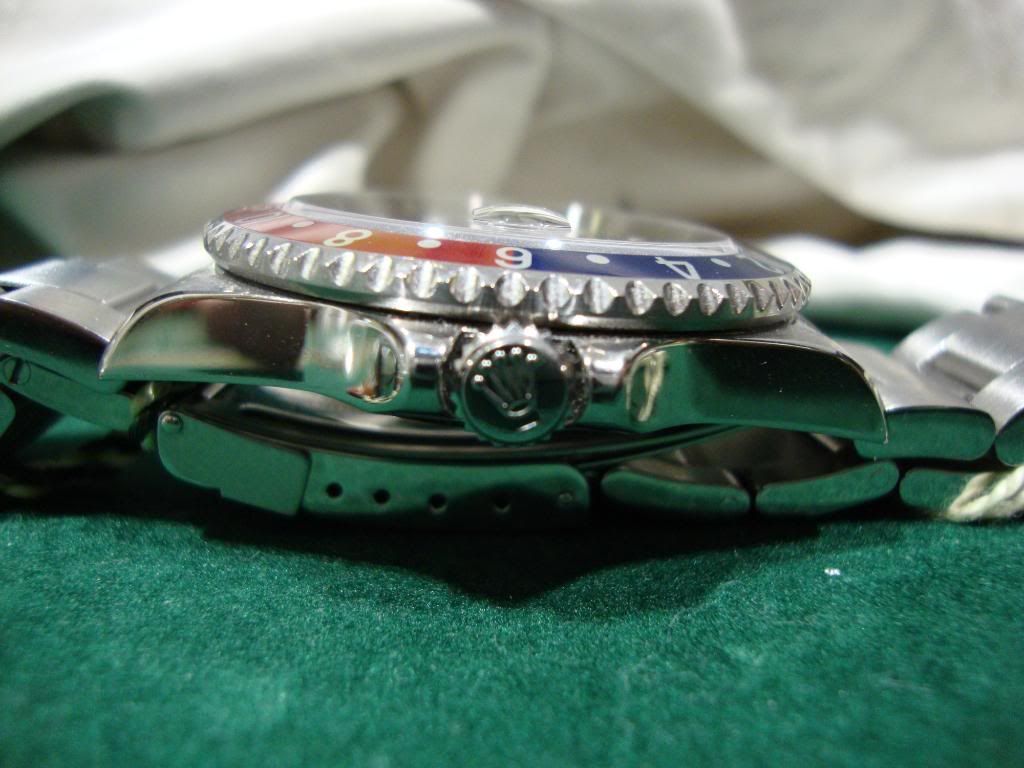
The brushed bracelet does help with this impression as well, and is classic Rolex sports watch through and through. The dial is clean and readable, even without the "maxi dial" of newer sports models. The red 24 hour hand contrasts nicely with the dial, and as such, is a very easy watch to read at a glance. My only criticism when it comes to looks is the small size of the twinlock crown - it doesn't quite look right on the case, and it is particularly fiddly to operate. Rolex addressed this problem by issuing the GMT IIc with the slightly larger Triplock. All in all, it looks great, and has aged very nicely - I certainly don't feel that it looks like a 20 year old watch, even though it first hit production lines that long ago.
The Feel
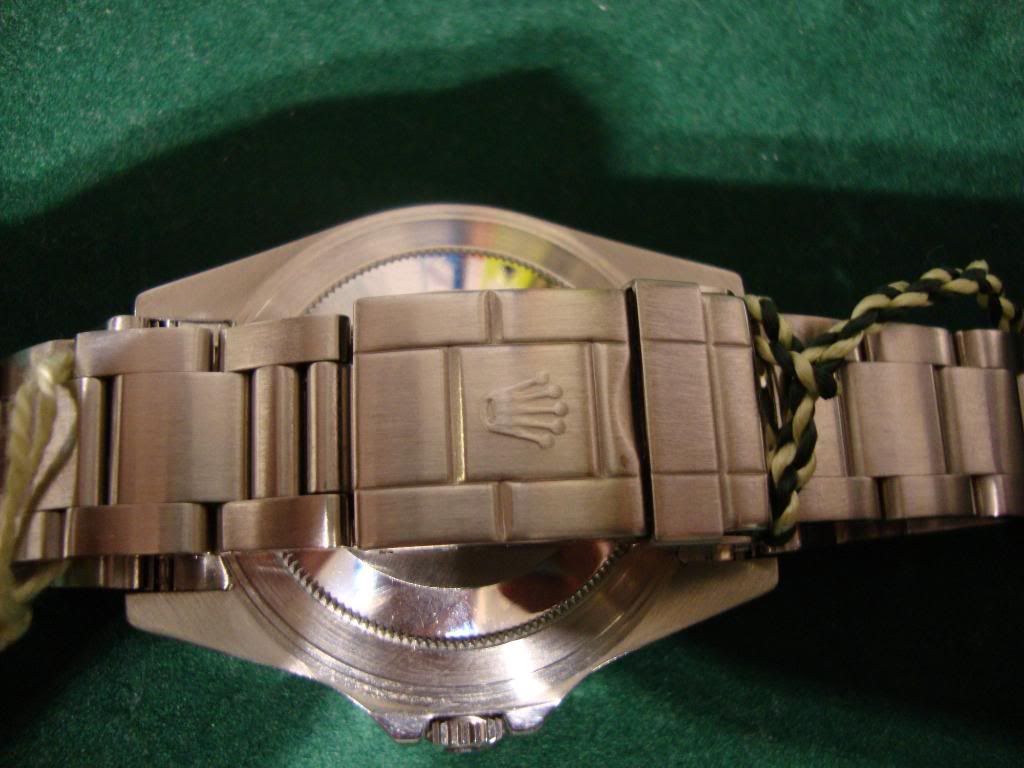
On this point, I feel I have to be a bit more critical of the GMT II. Whilst it might look fresh, it certainly feels like a 20 year old watch, much like the other Rolex models that have forgone updates for the time being. The bracelet is very light and rattly, even with solid end links. The clasp is functional, but doesn't inspire confidence - a very thin pressed metal clasp. Whilst purists will quickly point out that it's served the test of time (and they're spot on), I can't help but feel that the clasp seems cheaper than the one on my £150 Seiko Monster. It's not fitting of a watch of this reputation, and isn't a patch on the new clasps that Rolex have brought out. If you can afford it, a new Super Jubilee bracelet would be an excellent choice - it would completely transform the watch. Apart from that, it sits nice and closely to the wrist, and the micro-adjustments on the clasp mean you can get it to fit just right. I do realise this section is highly subjective, and for many people, the light bracelet and clasp won't be an issue: however, for me, if I was spending that kind of money on a watch, I'd want it to feel premium in every aspect.


Practicality
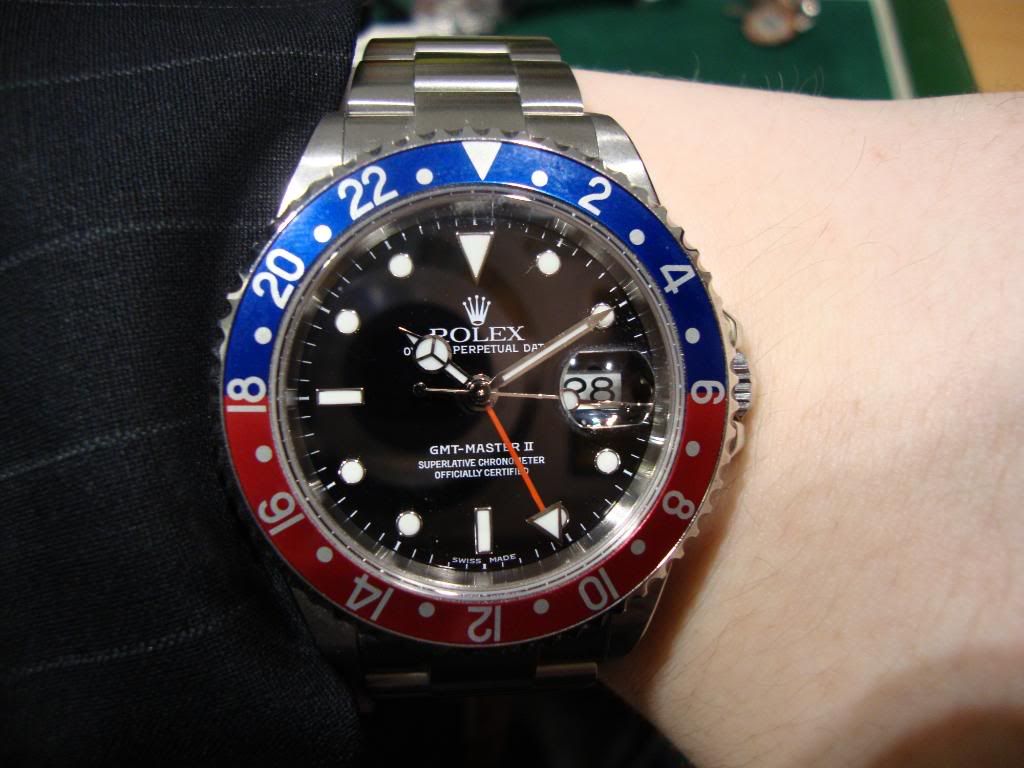
Well, what can I say? The GMT has always been Rolex's most practical watch, and this one is no exception. The perfect companion to any traveller, the three time zone feature has made it a long time favourite of commercial pilots. The low profile of the watch makes it a great everyday watch, and I think it looks great with just about anything. The watch is also a real chameleon - get all three inserts, a Jubilee bracelet, and a leather/NATO band, and you've got 9 different looks. Even Panerais aren't that versatile. I think this is probably the watch's strongest point, and makes it particularly unique. Having a brushed Oyster is always beneficial too, it certainy masks the scratches far better than models with polished centre links.

Conclusion
I do like this watch - the history, the looks, the practicality. However, that bracelet keeps holding me back, the one niggling issue, the fatal flaw. If this was on the new GMT's bracelet, I'd have it in a heartbeat. I think I have to come to a similar conclusion to my review of the 16610 - a great 20th Century watch, but feels out of place in the 21st century.
Thanks for reading,
The GMT Master
Technical Features
*Model ref. 16710
*Stainless steel case
*Bidirectional 24hr bezel, with choice of blue/red, red/black and black anodised aluminium inserts
*Case Diameter: 40mm
*Black sports dial with luminous (Superluminova) dot and baton markers w/ white gold surrounds
*Twinlock crown with crown guards
*Sapphire crystal with cyclops-magnified date
*24 hr. hand
*Independent hour hand - allows up to three time zones to be displayed concurrently
*Oyster Bracelet
The Movement
*Calibre 3185
*28.8k BPH
*Approx. 48 hour power reserve
*Self winding chronometer rated movement
*Semi-quickset date (done through independent hour hand)
*Nivarox hairspring
UK RRP: Discontinued. 2nd hand value of model posted: £2950.
The Aesthetics
That blue and red bezel combination makes this one of the most easily recognised Rolex models out there - it just screams "GMT." This might be too colourful for some, but I personally love it - practical, and iconic. If blue and red is too much, the other bezel inserts would certainly make it more understated. The numerals on the bezel are a little more subtle than on the GMT IIc, and I think it generally helps make the watch seem more rough and ready - a bona fide tool watch, as opposed to the "useful dress watch" appearance of the GMT IIc.
The brushed bracelet does help with this impression as well, and is classic Rolex sports watch through and through. The dial is clean and readable, even without the "maxi dial" of newer sports models. The red 24 hour hand contrasts nicely with the dial, and as such, is a very easy watch to read at a glance. My only criticism when it comes to looks is the small size of the twinlock crown - it doesn't quite look right on the case, and it is particularly fiddly to operate. Rolex addressed this problem by issuing the GMT IIc with the slightly larger Triplock. All in all, it looks great, and has aged very nicely - I certainly don't feel that it looks like a 20 year old watch, even though it first hit production lines that long ago.
The Feel
On this point, I feel I have to be a bit more critical of the GMT II. Whilst it might look fresh, it certainly feels like a 20 year old watch, much like the other Rolex models that have forgone updates for the time being. The bracelet is very light and rattly, even with solid end links. The clasp is functional, but doesn't inspire confidence - a very thin pressed metal clasp. Whilst purists will quickly point out that it's served the test of time (and they're spot on), I can't help but feel that the clasp seems cheaper than the one on my £150 Seiko Monster. It's not fitting of a watch of this reputation, and isn't a patch on the new clasps that Rolex have brought out. If you can afford it, a new Super Jubilee bracelet would be an excellent choice - it would completely transform the watch. Apart from that, it sits nice and closely to the wrist, and the micro-adjustments on the clasp mean you can get it to fit just right. I do realise this section is highly subjective, and for many people, the light bracelet and clasp won't be an issue: however, for me, if I was spending that kind of money on a watch, I'd want it to feel premium in every aspect.
Practicality
Well, what can I say? The GMT has always been Rolex's most practical watch, and this one is no exception. The perfect companion to any traveller, the three time zone feature has made it a long time favourite of commercial pilots. The low profile of the watch makes it a great everyday watch, and I think it looks great with just about anything. The watch is also a real chameleon - get all three inserts, a Jubilee bracelet, and a leather/NATO band, and you've got 9 different looks. Even Panerais aren't that versatile. I think this is probably the watch's strongest point, and makes it particularly unique. Having a brushed Oyster is always beneficial too, it certainy masks the scratches far better than models with polished centre links.
Conclusion
I do like this watch - the history, the looks, the practicality. However, that bracelet keeps holding me back, the one niggling issue, the fatal flaw. If this was on the new GMT's bracelet, I'd have it in a heartbeat. I think I have to come to a similar conclusion to my review of the 16610 - a great 20th Century watch, but feels out of place in the 21st century.
Thanks for reading,
The GMT Master
Saturday, 16 January 2010
Rolex Datejust II - Review
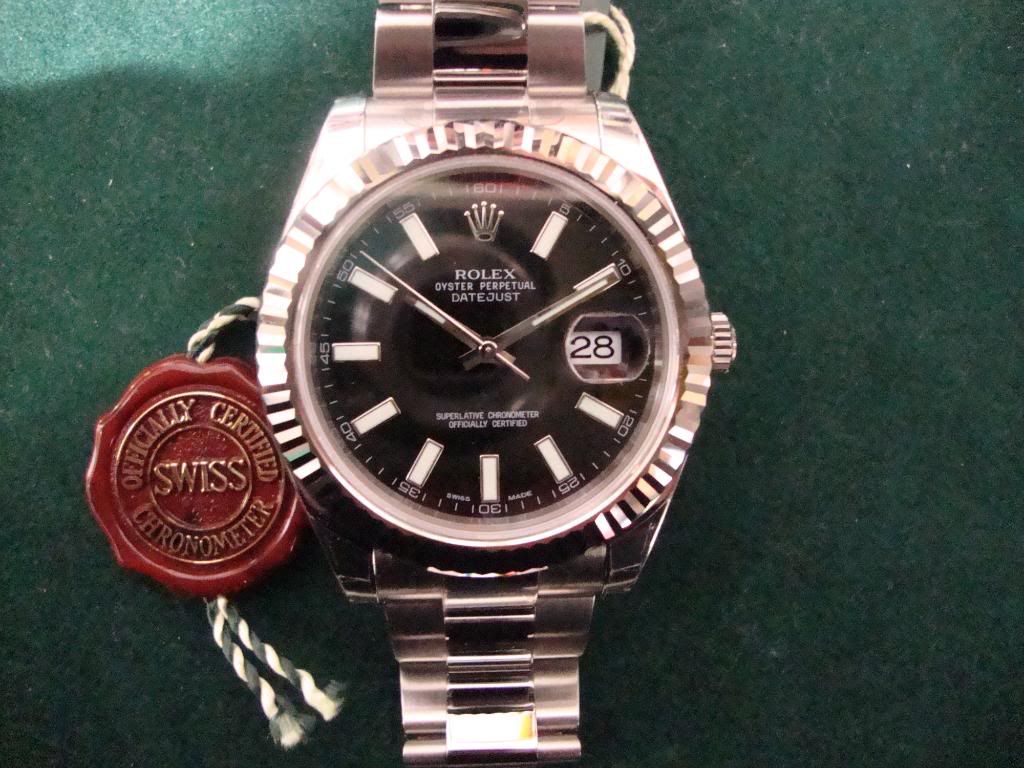
The Datejust II is the latest update to the long serving Datejust range, and this is arguably the most radical interpretation of the classic date watch that Rolex have ever done. It has a large size increase over the standard gent's Datejust, and is certainly a striking piece to look at. As such, the watch has divided opinion, with some arguing that it is simply too big to be a dress watch. On the other hand, it has turned what many perceive as a watch for the older man into very much a younger man's watch, and is certainly an interesting addition to the big watch parade. This article will assess features, looks, wearability and build quality, with a few pictures along the way. The model reviewed is the steel and 18Ct white gold model.

Technical Features
*Model number: 166334
*904 L steel case and bracelet
*18ct White Gold Fluted bezel
*Case Diameter: 41mm
*Choice of dials, model reviewed - Black baton dial, w/ luminous hands and markers, arabics around the circumference
*Twinlock crown
*Sapphire crystal w/ cyclops date magnifier (Antireflective coating on underside of cyclops)
*Oyster bracelet with Oysterclasp
*Waterproof 100m/330Ft
The Movement
*Cal. 3136 (exclusive to the Datejust II)
*28.8k BPH
*Self-winding, chronometer rated
*Quickset date complication
*Parachrom blue hairspring, Paraflex shock absorbers
UK RRP: £4940
The Aesthetics
The two most striking aspects about this watch is how big it seems, and how prominent the bezel is. Although the case diameter is essentially the same as, say, a Submariner or a GMT IIc, it appears larger than them placed side by side. I believe this is largely due to the size of the dial - with the bezel being thinner than the rotating ones on the sports models, the dial stretches further, which gives the appearance of a larger surface area on the wrist. That's not to say that the bezel is a shrinking violet - far from it. The dial to bezel ratios are more biased towards the bezel than on the 36mm equivalent (ref. 116234), making it really sparkle. Some people have expressed that they think it's too prominent, but I disagree - if it was any thinner, it would mean the dial would be even larger, and would make the watch begin to look odd on the wrist. You really need to see the bezel and the way it catches the light to appreciate it - it truly is a thing of beauty.
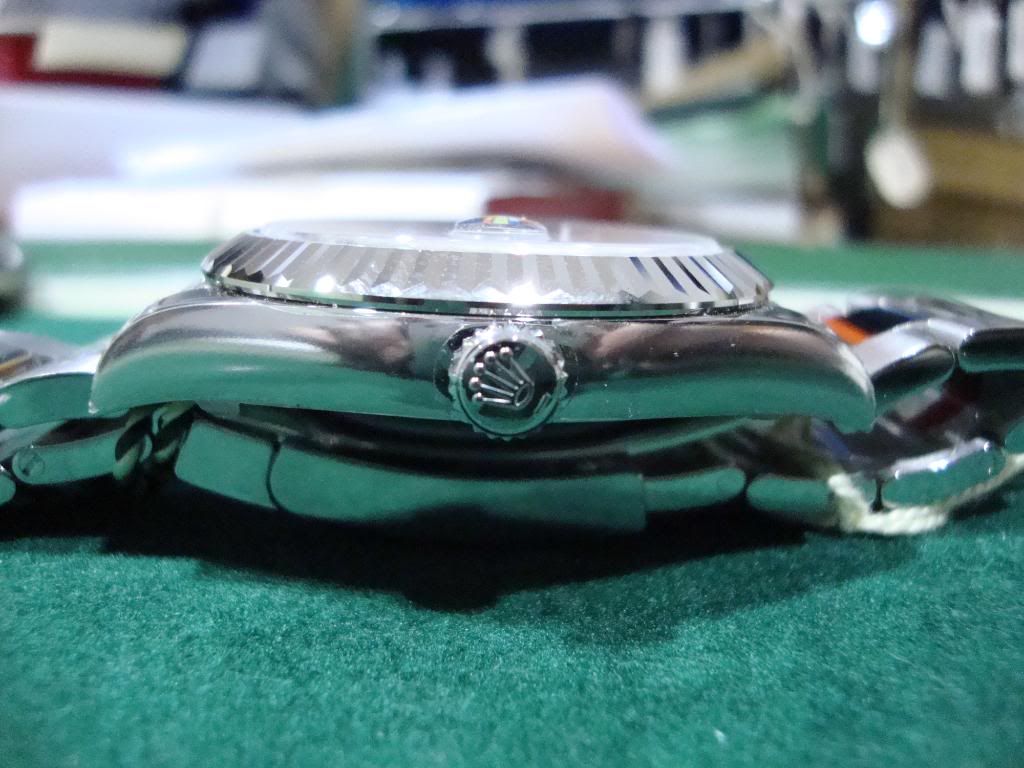
Another aspect of note is the size of the crown in relation to the watch. Rolex have decided to utilise the Twinlock crown on the Datejust II, the same as on the 36mm model. Whilst it looks spot on on the smaller watch, it seems a little disproportionate on a 41mm case. In a similar way to how they upgraded the crown on the GMT IIc to the Triplock, they probably should have done the same on the Datejust II. Finally, despite the large case diameter, the thickness of the watch is quite reasonable, which should mean it'll still fit nicely under a shirt cuff.

Practicality
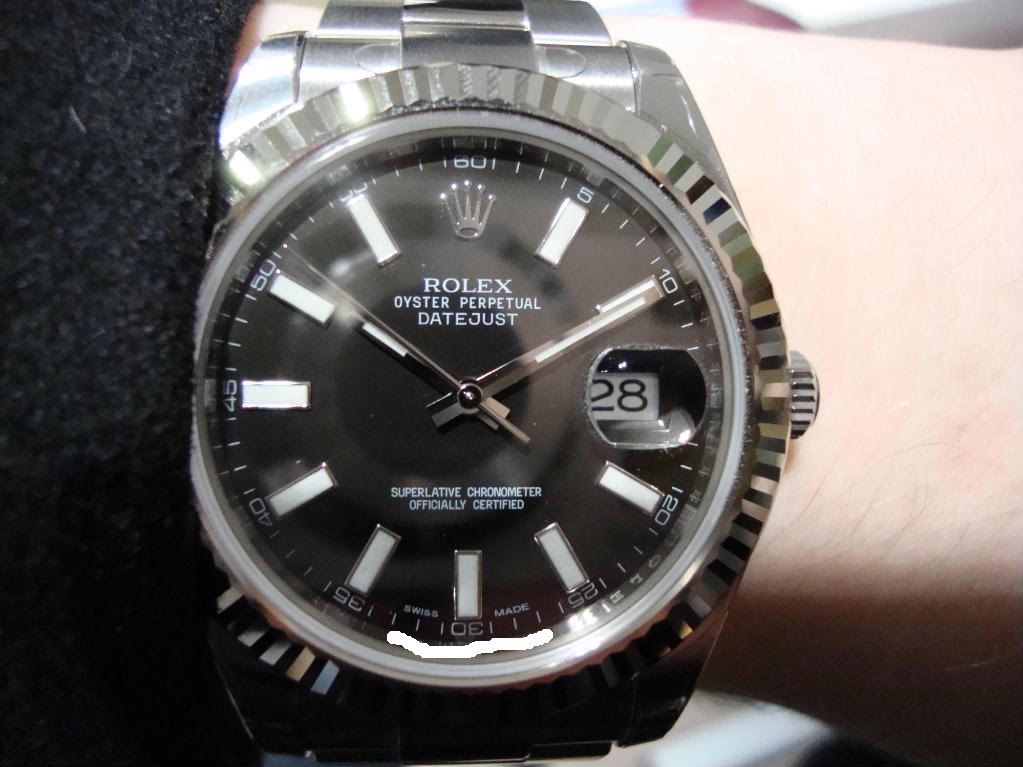
I think this watch is a great addition to the range for those who want a smart looking dress watch that's a bit more substantial. I know I have small wrists, and the 36mm Datejust looks pretty good on me, but for men with larger wrists, it might not look right. Yes, it's a step away from classic Rolex sizing, but there's nothing wrong with offering more choice. People are wearing far bigger watches these days, with 45 and 50mm watches becoming more and more popular. In any case, the Datejust II isn't as radical as some would make out, and it is certainly more wearable than a lot of other oversize watches. Crucially, unlike the Deepsea, the thickness of the watch is reasonable, and that's the killer aspect when it comes to wearability.
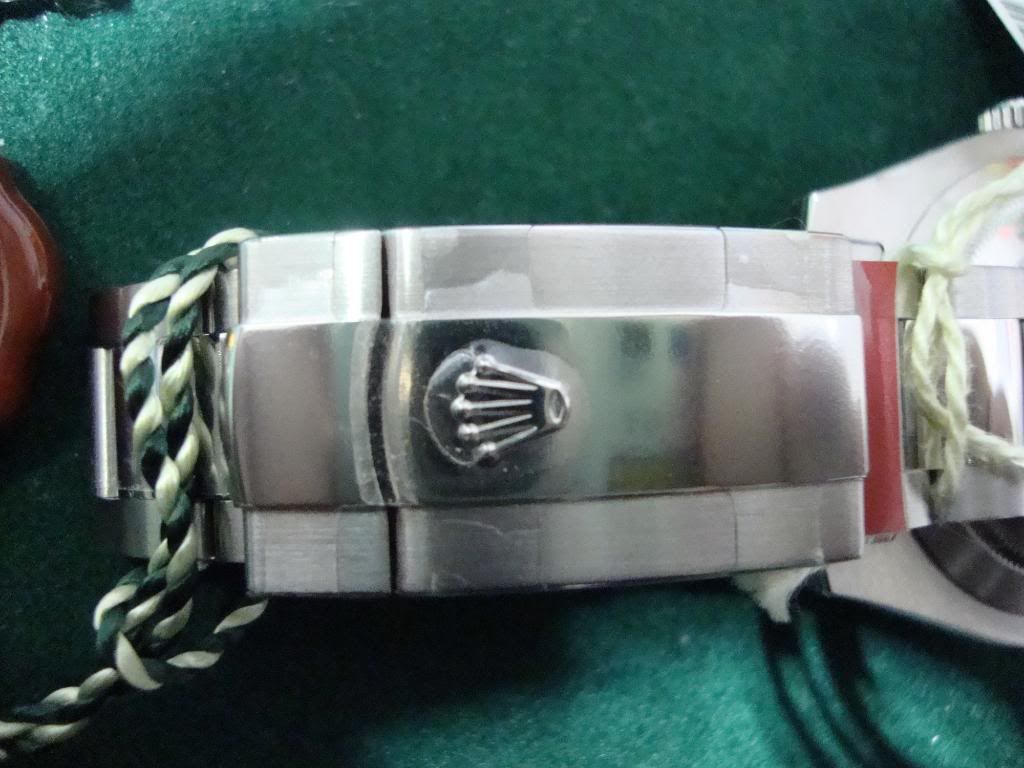
In terms of comfort, it's on the latest incarnation of the Oyster bracelet - solid end links and solid centre links. Solid, practical, and comfortable - you won't have any problems with hairs getting caught. There is some room for microadjustment on the clasp, and it also features the Easylink - an extra half link that can be concealed or extended. It's not as good as the Glidelock adjustment you can find on Rolex's diving watches, but it means you can still get the watch nice and comfortable. The clasp itself is solid and well engineered - Rolex have gone from producing some of the most basic clasps on the market to some of the best. It certainly gives you a sense of confidence whilst wearing it. The watch is relatively weighty, but not to the point where it's unconfortable - you know it's there, it's a feeling of security.

Value for Money
Okay, at a shade under £5000, it's not a cheap watch. It's about a 20% increase on the price of a 116234, and are you getting more watch for your money? Hard to say - obviously there's more gold in the bezel, and the 3136 is an entirely in-house movement (I'm not entirely sure what differences there are between the 3135 and the 3136, my feeling is that there won't be a significant change.) It also goes with the usual Rolex practice of the larger the watch in a family, the more expensive it is. For the time being, dial choices are relatively limited compared to the 36mm Datejust and only the fluted bezel and Oyster bracelet are available. I expect a Jubilee bracelet and Polished bezel to become available in the future, as well as more dials - keep an eye out at Basel, they might decide to launch some then. In terms of engineering, it can't be faulted. Feels and looks like a premium watch should, and the quality is bound to be extremely high too. Initially, it'll be a relatively exclusive watch, but it won't hold its value as well as the sports models.
Conclusion
I have to admit, this watch isn't for me - just a bit too big for my wrists. However, I can appreciate and understand what Rolex are aiming for with this watch. The oversized watch market is big business at the moment, and, for me, the Datejust II fills a nice niche, and is certainly a lot dressier and practical than a lot of other large watches. It's helped to revitalise a staple of the Rolex range, and I really hope this introduces a new generation to the brand, and shakes off the "old man" image that Rolex seem to have developed recently.

Technical Features
*Model number: 166334
*904 L steel case and bracelet
*18ct White Gold Fluted bezel
*Case Diameter: 41mm
*Choice of dials, model reviewed - Black baton dial, w/ luminous hands and markers, arabics around the circumference
*Twinlock crown
*Sapphire crystal w/ cyclops date magnifier (Antireflective coating on underside of cyclops)
*Oyster bracelet with Oysterclasp
*Waterproof 100m/330Ft
The Movement
*Cal. 3136 (exclusive to the Datejust II)
*28.8k BPH
*Self-winding, chronometer rated
*Quickset date complication
*Parachrom blue hairspring, Paraflex shock absorbers
UK RRP: £4940
The Aesthetics
The two most striking aspects about this watch is how big it seems, and how prominent the bezel is. Although the case diameter is essentially the same as, say, a Submariner or a GMT IIc, it appears larger than them placed side by side. I believe this is largely due to the size of the dial - with the bezel being thinner than the rotating ones on the sports models, the dial stretches further, which gives the appearance of a larger surface area on the wrist. That's not to say that the bezel is a shrinking violet - far from it. The dial to bezel ratios are more biased towards the bezel than on the 36mm equivalent (ref. 116234), making it really sparkle. Some people have expressed that they think it's too prominent, but I disagree - if it was any thinner, it would mean the dial would be even larger, and would make the watch begin to look odd on the wrist. You really need to see the bezel and the way it catches the light to appreciate it - it truly is a thing of beauty.
Another aspect of note is the size of the crown in relation to the watch. Rolex have decided to utilise the Twinlock crown on the Datejust II, the same as on the 36mm model. Whilst it looks spot on on the smaller watch, it seems a little disproportionate on a 41mm case. In a similar way to how they upgraded the crown on the GMT IIc to the Triplock, they probably should have done the same on the Datejust II. Finally, despite the large case diameter, the thickness of the watch is quite reasonable, which should mean it'll still fit nicely under a shirt cuff.
Practicality
I think this watch is a great addition to the range for those who want a smart looking dress watch that's a bit more substantial. I know I have small wrists, and the 36mm Datejust looks pretty good on me, but for men with larger wrists, it might not look right. Yes, it's a step away from classic Rolex sizing, but there's nothing wrong with offering more choice. People are wearing far bigger watches these days, with 45 and 50mm watches becoming more and more popular. In any case, the Datejust II isn't as radical as some would make out, and it is certainly more wearable than a lot of other oversize watches. Crucially, unlike the Deepsea, the thickness of the watch is reasonable, and that's the killer aspect when it comes to wearability.
In terms of comfort, it's on the latest incarnation of the Oyster bracelet - solid end links and solid centre links. Solid, practical, and comfortable - you won't have any problems with hairs getting caught. There is some room for microadjustment on the clasp, and it also features the Easylink - an extra half link that can be concealed or extended. It's not as good as the Glidelock adjustment you can find on Rolex's diving watches, but it means you can still get the watch nice and comfortable. The clasp itself is solid and well engineered - Rolex have gone from producing some of the most basic clasps on the market to some of the best. It certainly gives you a sense of confidence whilst wearing it. The watch is relatively weighty, but not to the point where it's unconfortable - you know it's there, it's a feeling of security.
Value for Money
Okay, at a shade under £5000, it's not a cheap watch. It's about a 20% increase on the price of a 116234, and are you getting more watch for your money? Hard to say - obviously there's more gold in the bezel, and the 3136 is an entirely in-house movement (I'm not entirely sure what differences there are between the 3135 and the 3136, my feeling is that there won't be a significant change.) It also goes with the usual Rolex practice of the larger the watch in a family, the more expensive it is. For the time being, dial choices are relatively limited compared to the 36mm Datejust and only the fluted bezel and Oyster bracelet are available. I expect a Jubilee bracelet and Polished bezel to become available in the future, as well as more dials - keep an eye out at Basel, they might decide to launch some then. In terms of engineering, it can't be faulted. Feels and looks like a premium watch should, and the quality is bound to be extremely high too. Initially, it'll be a relatively exclusive watch, but it won't hold its value as well as the sports models.
Conclusion
I have to admit, this watch isn't for me - just a bit too big for my wrists. However, I can appreciate and understand what Rolex are aiming for with this watch. The oversized watch market is big business at the moment, and, for me, the Datejust II fills a nice niche, and is certainly a lot dressier and practical than a lot of other large watches. It's helped to revitalise a staple of the Rolex range, and I really hope this introduces a new generation to the brand, and shakes off the "old man" image that Rolex seem to have developed recently.
Tuesday, 15 December 2009
A Friendly Dive Watch Comparison: Submariner vs. Seamaster Professional
Firstly, my apologies for not updating the blog more recently - work has been catching up with me, hence why it's been a little quiet over here. However, I have a few new articles I've been working on, which should hopefully be written up within the next few days.
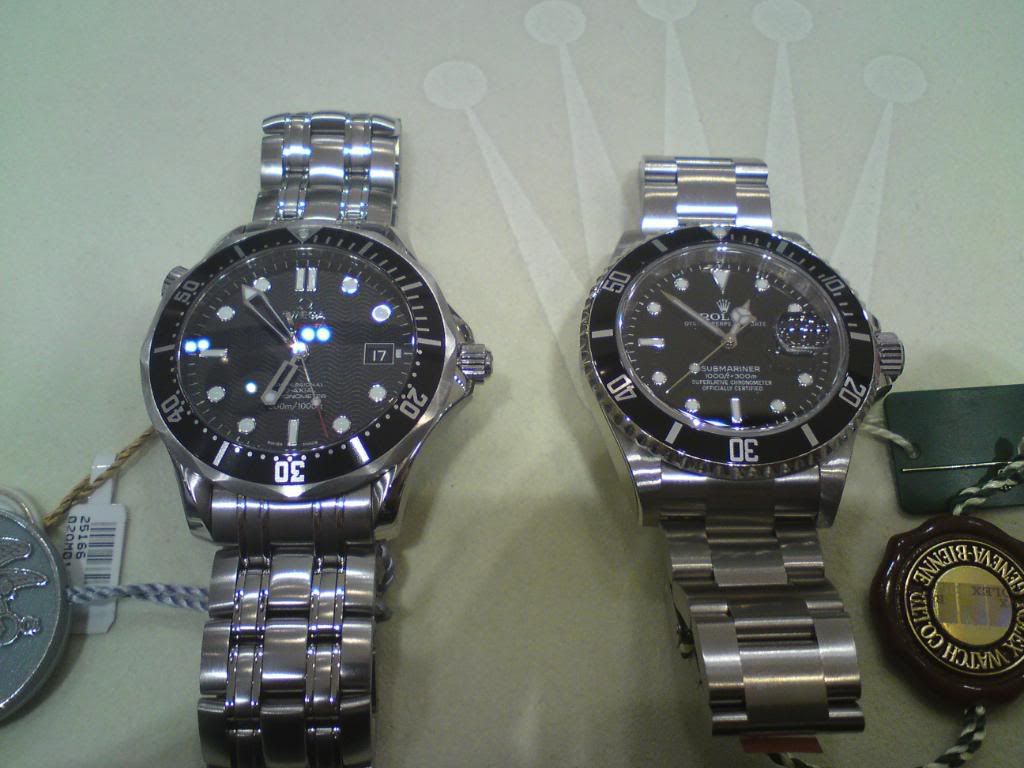
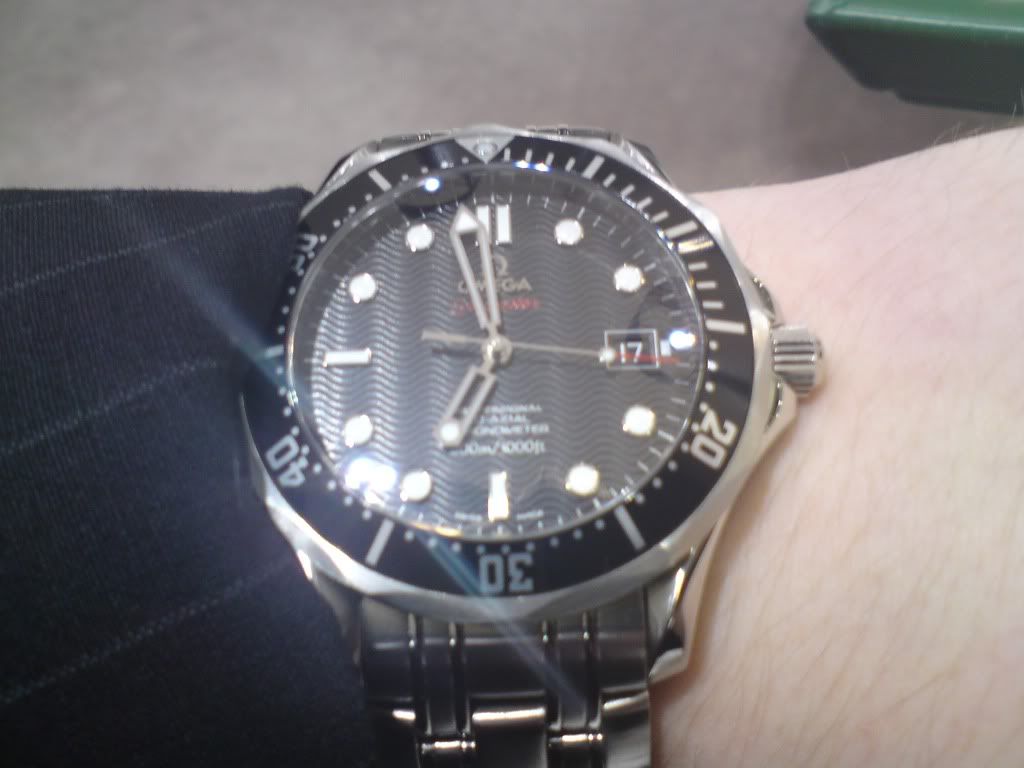
The first of which is a comparison between two icons of the diving watch world: the Rolex Submariner Date and the Omega Seamaster Professional. With the introduction of the black dialled version, as well as Omega's reluctance to push prices up as steeply as Rolex, the Seamaster is looking like a better and better buy every day. Conversely, despite coming to the end of its operational life, the Submariner continues to be one of the most popular models in the Rolex range, and has amassed a serious fanbase since its original inception in 1953. The models I will be reviewing are the Submariner 16610, and the Seamaster 212.30.41.20.01.002.

Technical Specifications (Sub vs. SMP)
Case Diameter: 40mm - 41mm
Cal. Number: Rolex 3135 - Omega 2500
Automatic?: Yes - Yes
BPH: 28.8k - 25.2k
Power Reserve: ~40 hours - 48 hours
COSC Certified?: Yes - Yes
Material: 904L Steel - 316L Steel
Waterproofing: 300m - 300m
Screw-down crown?: Yes - Yes
Helium Escape Valve?: No - Yes
Crystal: Sapphire - Sapphire
Anti-reflective coating?: No - Inside only
Luminous Material: Green Super-Luminova - Blue Super-Luminova
Unidirectional Rotating Bezel?: Yes - Yes
Price (UK RRP): £3890 - £1860
The Aesthetics
With the introduction of the black dial on the SMP, there is very little to distinguish between the two at a glance, at least with an untrained eye. Indeed, the basic dial layout of dots-and-dashes hour markers is the classic dive watch look - simple, practical, legible. The biggest difference on the dial itself is the finish - the Submariner goes for a gloss finish, whilst the Seamaster adopts a wave finish, designed to reduce glare whilst diving.
The other large cosmetic difference on the face of the watch would be the cyclops magnifying bubble on the Sub - although some really don't like this feature, I, for one, think it's an essential part of the Rolex look, and handy for looking at the date quickly. The date window on the SMP is pretty small, and can be difficult to read at a glance. As a general rule, the Submariner is a lot shinier than the Seamaster, owing to the gloss finish and lack of AR coating, and whilst this makes for a "dressier" look, it could be a potential problem for legibility in bright light.
As such, there is little to separate the watches in terms of aesthetics, and it really boils down to personal preference. For me, the Rolex just edges it in this respect.
The Bracelet
It's my personal view that the bracelet is just as important as the watch head when considering a watch - after all, the bracelet and clasp determines the "feel" of the watch, and dictates how comfortable it is to wear every day. Certainly, there is a large difference between the two watches in regards to this.
The Submariner uses a brushed-finish Oyster bracelet, with solid end links, but hollow centre links, whilst the SMP uses an exclusive bracelet with polished higlights and solid links throughout. The first thing that I noticed with the Submariner bracelet is just how light the bracelet felt - a positive for someone who wants a dive-watch without the typical dive-watch heft - but also how rattly it felt. One has to bear in mind that the 16610 was launched 20 years ago, and it really is beginning to feel like its age. Submariner enthusiasts will point out that it's a strong and reliable bracelet, ready to take the abuses of every day life, and I completely agree. However, when you put it against one of the new-style Rolex bracelets, such as the one on the GMT IIc, the Submariner's band just feels cheap.
The Seamaster's bracelet, on the other hand, gives the wearer a feeling of confidence. It's substantial without being overbearing, and sits nicely on the wrist. It also looks a little dressier than the Rolex's, with the polished sections of the links just giving it a little bit of contrast.
There's a similar story with the clasps - the best word to describe the Submariner's clasp is outdated. It still uses the folded-metal clasp, which is wafer thin, and, to be quite frank, would feel wrong on a £500 watch, let alone a near-£4000 watch. Again, it can be argued that it's served it's purpose for a long time, and I won't deny that, but placed against the brilliant Glidelock clasp (see the Deepsea Review if you haven't come across it yet), it feels like an ancient relic:

I certainly think that the clasp is the biggest drawback on the Submariner, especially in comparison to the Omega clasp:

The Omega uses a push putton deployment clasp which won't have the same problems with the blades bending over time like the Submariner. It feels like a more heavy-duty clasp as well, and the quality of the engineering can't be faulted. Indeed, some argue that Omega's clasps sparked Rolex's drive for updating their own clasps. Omega wins convincingly here.
The Practicality
The Submariner has long been known as one of the best all-rounders out there - bash it around by day, and it'll still look perfect with a tuxedo. It truly is one of the watch world's greatest chameleons. The "James Bond" aspect has a lot to do with this, and applies to both watches - for someone who wants just one watch that can do everything, then the Sub or the SMP is a worthy choice. Neither are particularly chunky, so wearing one under a cuff isn't an issue. There's virtually nothing to distinguish between the two in this respect. A tie.
Value for Money
As I've asserted throughout the article, in many respects, the SMP is the equal of the Submariner, and in other respects, its superior. Indeed, the biggest difference between the two watches is the price, and I don't think this reflects the quality of the watches - the Submariner certainly isn't double the watch that the Seamaster is. It should also be noted that, due to the use of the Co-Axial escapement in the Seamaster, you get a 3 year guarantee on the Omega, as opposed to the 2 year on the Rolex. When buying new, there's also a bigger scope for discount on a Seamaster as well - most ADs will be unwilling to give more than a token discount on a Submariner owing to its continued popularity. Whilst buying new makes the Omega the rational choice, one also has to take into account resale value, and this is where the Rolex really comes into play. You can always rely on a steel sports Rolex to hold a substantial amount of its value, even a few years down the line. However, the depreciation on an Omega is brutal, and you'll struggle to sell it for muh more than half the RRP a year down the line. In some respects, you are paying extra for the Rolex marque, but it will help to give you a better return should you want to move on further down the line
However, it must be noted that an updated Submariner is expected to be launched in March 2010, hitting ADs in this country in around October/November. Whilst this might spark a small spike in demand for the 16610 as its phased out (in th same way there was a small hype for V-series Sea-Dwellers before the arrival of the Deep Sea), in the long term it will, in all likelihood, give second hand values of the 16610 a beatung. As such, the Submariner isn't quite the safe investment that it used to be.
Omega wins on value for money.
Conclusion
The Submariner 16610 has done the Rolex range proud for the past 20 years, and I'd argue that it's the pinnacle of 20th Century dive watches. The allure that it's created is simply phenomenal, and the fact that it's lasted such a long time pays a compliment to Rolex's overengineering at the time. However, its time has come to an end, and for the past few years, the Seamaster has been the sensible choice. I expect things will shift back into Rolex's favour come Basel 2010, and I can't wait for the rebirth of such an iconic watch.

If you asked me tomorrow which one to buy, I'd personally go for the Seamaster - it's quite possibly the best value luxury watch on the market. However, regardless of a rational approach, the Submariner does have the Rolex "magic," and that, for some, will be enough.

On a final note, if you want to get your hands on a new 16610, don't hang around - according to sources on TRF, Rolex USA has already run out of stock of them, and won't be getting any more steel Subs until the new model arrives. I don't know for certain whether this will be the case in the UK - as far as I'm aware, Rolex UK still has supplies in stock.
Thanks for reading
The GMT Master
The first of which is a comparison between two icons of the diving watch world: the Rolex Submariner Date and the Omega Seamaster Professional. With the introduction of the black dialled version, as well as Omega's reluctance to push prices up as steeply as Rolex, the Seamaster is looking like a better and better buy every day. Conversely, despite coming to the end of its operational life, the Submariner continues to be one of the most popular models in the Rolex range, and has amassed a serious fanbase since its original inception in 1953. The models I will be reviewing are the Submariner 16610, and the Seamaster 212.30.41.20.01.002.
Technical Specifications (Sub vs. SMP)
Case Diameter: 40mm - 41mm
Cal. Number: Rolex 3135 - Omega 2500
Automatic?: Yes - Yes
BPH: 28.8k - 25.2k
Power Reserve: ~40 hours - 48 hours
COSC Certified?: Yes - Yes
Material: 904L Steel - 316L Steel
Waterproofing: 300m - 300m
Screw-down crown?: Yes - Yes
Helium Escape Valve?: No - Yes
Crystal: Sapphire - Sapphire
Anti-reflective coating?: No - Inside only
Luminous Material: Green Super-Luminova - Blue Super-Luminova
Unidirectional Rotating Bezel?: Yes - Yes
Price (UK RRP): £3890 - £1860
The Aesthetics
With the introduction of the black dial on the SMP, there is very little to distinguish between the two at a glance, at least with an untrained eye. Indeed, the basic dial layout of dots-and-dashes hour markers is the classic dive watch look - simple, practical, legible. The biggest difference on the dial itself is the finish - the Submariner goes for a gloss finish, whilst the Seamaster adopts a wave finish, designed to reduce glare whilst diving.
The other large cosmetic difference on the face of the watch would be the cyclops magnifying bubble on the Sub - although some really don't like this feature, I, for one, think it's an essential part of the Rolex look, and handy for looking at the date quickly. The date window on the SMP is pretty small, and can be difficult to read at a glance. As a general rule, the Submariner is a lot shinier than the Seamaster, owing to the gloss finish and lack of AR coating, and whilst this makes for a "dressier" look, it could be a potential problem for legibility in bright light.
As such, there is little to separate the watches in terms of aesthetics, and it really boils down to personal preference. For me, the Rolex just edges it in this respect.
The Bracelet
It's my personal view that the bracelet is just as important as the watch head when considering a watch - after all, the bracelet and clasp determines the "feel" of the watch, and dictates how comfortable it is to wear every day. Certainly, there is a large difference between the two watches in regards to this.
The Submariner uses a brushed-finish Oyster bracelet, with solid end links, but hollow centre links, whilst the SMP uses an exclusive bracelet with polished higlights and solid links throughout. The first thing that I noticed with the Submariner bracelet is just how light the bracelet felt - a positive for someone who wants a dive-watch without the typical dive-watch heft - but also how rattly it felt. One has to bear in mind that the 16610 was launched 20 years ago, and it really is beginning to feel like its age. Submariner enthusiasts will point out that it's a strong and reliable bracelet, ready to take the abuses of every day life, and I completely agree. However, when you put it against one of the new-style Rolex bracelets, such as the one on the GMT IIc, the Submariner's band just feels cheap.
The Seamaster's bracelet, on the other hand, gives the wearer a feeling of confidence. It's substantial without being overbearing, and sits nicely on the wrist. It also looks a little dressier than the Rolex's, with the polished sections of the links just giving it a little bit of contrast.
There's a similar story with the clasps - the best word to describe the Submariner's clasp is outdated. It still uses the folded-metal clasp, which is wafer thin, and, to be quite frank, would feel wrong on a £500 watch, let alone a near-£4000 watch. Again, it can be argued that it's served it's purpose for a long time, and I won't deny that, but placed against the brilliant Glidelock clasp (see the Deepsea Review if you haven't come across it yet), it feels like an ancient relic:
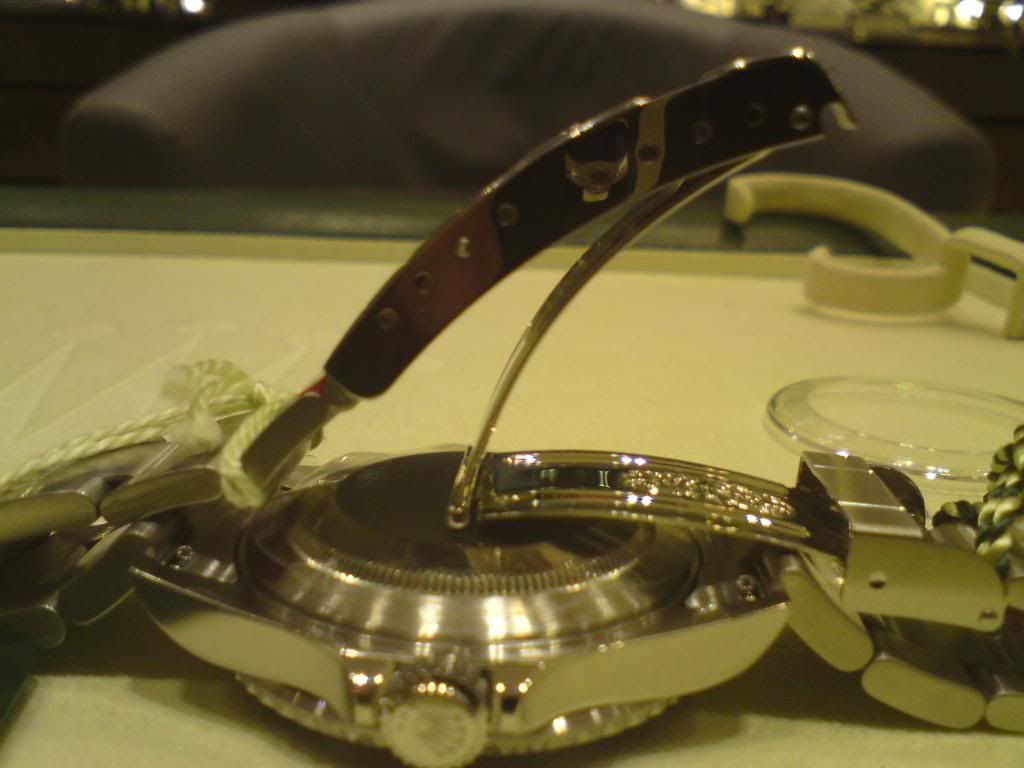
I certainly think that the clasp is the biggest drawback on the Submariner, especially in comparison to the Omega clasp:
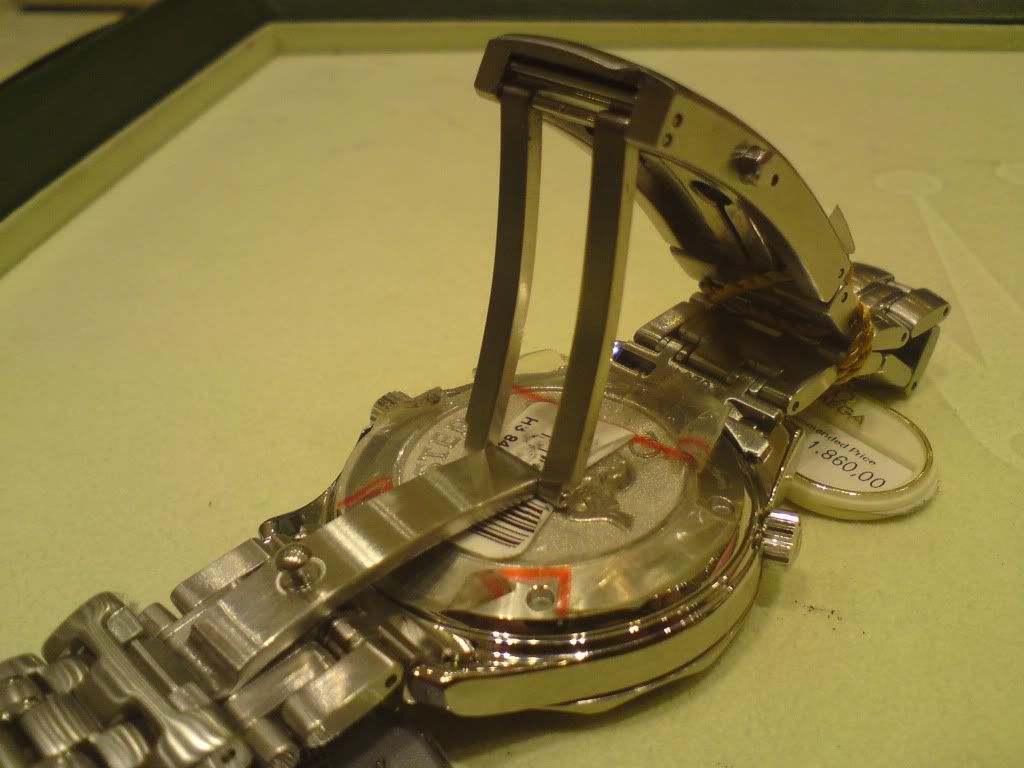
The Omega uses a push putton deployment clasp which won't have the same problems with the blades bending over time like the Submariner. It feels like a more heavy-duty clasp as well, and the quality of the engineering can't be faulted. Indeed, some argue that Omega's clasps sparked Rolex's drive for updating their own clasps. Omega wins convincingly here.
The Practicality
The Submariner has long been known as one of the best all-rounders out there - bash it around by day, and it'll still look perfect with a tuxedo. It truly is one of the watch world's greatest chameleons. The "James Bond" aspect has a lot to do with this, and applies to both watches - for someone who wants just one watch that can do everything, then the Sub or the SMP is a worthy choice. Neither are particularly chunky, so wearing one under a cuff isn't an issue. There's virtually nothing to distinguish between the two in this respect. A tie.
Value for Money
As I've asserted throughout the article, in many respects, the SMP is the equal of the Submariner, and in other respects, its superior. Indeed, the biggest difference between the two watches is the price, and I don't think this reflects the quality of the watches - the Submariner certainly isn't double the watch that the Seamaster is. It should also be noted that, due to the use of the Co-Axial escapement in the Seamaster, you get a 3 year guarantee on the Omega, as opposed to the 2 year on the Rolex. When buying new, there's also a bigger scope for discount on a Seamaster as well - most ADs will be unwilling to give more than a token discount on a Submariner owing to its continued popularity. Whilst buying new makes the Omega the rational choice, one also has to take into account resale value, and this is where the Rolex really comes into play. You can always rely on a steel sports Rolex to hold a substantial amount of its value, even a few years down the line. However, the depreciation on an Omega is brutal, and you'll struggle to sell it for muh more than half the RRP a year down the line. In some respects, you are paying extra for the Rolex marque, but it will help to give you a better return should you want to move on further down the line
However, it must be noted that an updated Submariner is expected to be launched in March 2010, hitting ADs in this country in around October/November. Whilst this might spark a small spike in demand for the 16610 as its phased out (in th same way there was a small hype for V-series Sea-Dwellers before the arrival of the Deep Sea), in the long term it will, in all likelihood, give second hand values of the 16610 a beatung. As such, the Submariner isn't quite the safe investment that it used to be.
Omega wins on value for money.
Conclusion
The Submariner 16610 has done the Rolex range proud for the past 20 years, and I'd argue that it's the pinnacle of 20th Century dive watches. The allure that it's created is simply phenomenal, and the fact that it's lasted such a long time pays a compliment to Rolex's overengineering at the time. However, its time has come to an end, and for the past few years, the Seamaster has been the sensible choice. I expect things will shift back into Rolex's favour come Basel 2010, and I can't wait for the rebirth of such an iconic watch.
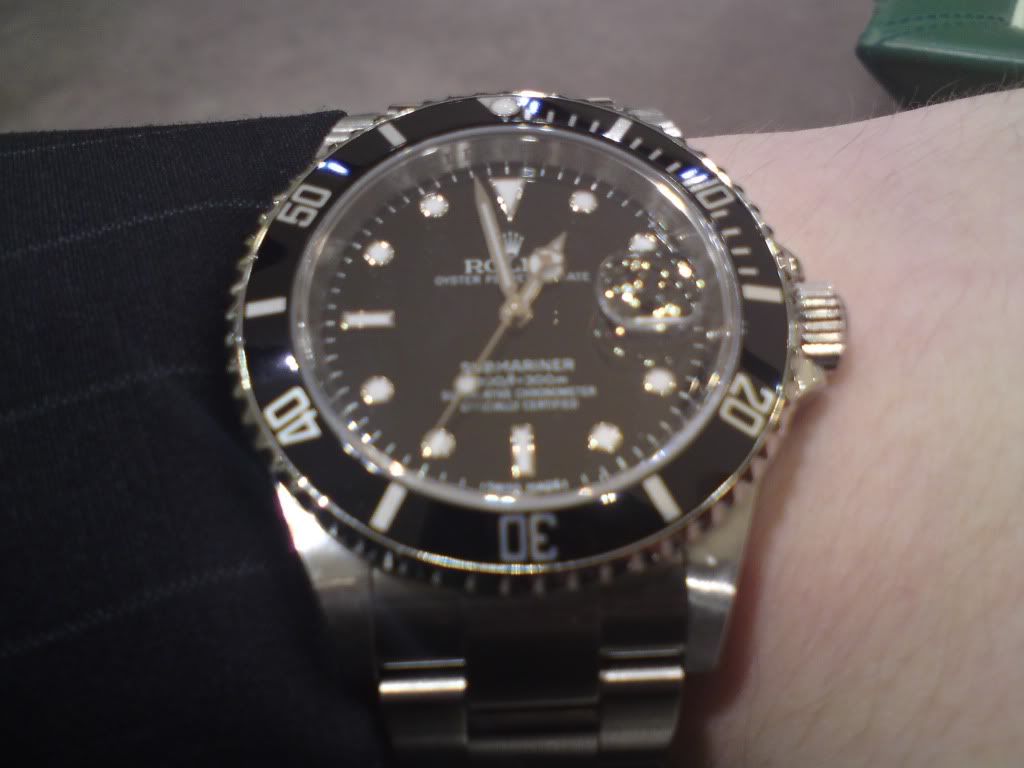
If you asked me tomorrow which one to buy, I'd personally go for the Seamaster - it's quite possibly the best value luxury watch on the market. However, regardless of a rational approach, the Submariner does have the Rolex "magic," and that, for some, will be enough.
On a final note, if you want to get your hands on a new 16610, don't hang around - according to sources on TRF, Rolex USA has already run out of stock of them, and won't be getting any more steel Subs until the new model arrives. I don't know for certain whether this will be the case in the UK - as far as I'm aware, Rolex UK still has supplies in stock.
Thanks for reading
The GMT Master
Thursday, 17 September 2009
Rolex Sea Dweller Deep Sea
Big. Everything about this watch is big: the size, the depth rating, the price. It's the most extreme diving watch that Rolex have ever offered for sale, the only other watch they've ever made that can outdo it is the Deep Sea Special, which wasn't exactly a daily wearer. It's certainly an impressive watch - but is it as good as the hype would have you believe, and is it a viable watch for the ordinary watch wearer? I'll weigh up the pros and cons and come to my decision, and hopefully it might help yours as well.

Techincal Details
*Model Number: 116660
*904L Stainless Steel
*43mm Case Diameter
*Unidirectional rotating diving bezel, ceramic bezel insert with platinum numerals
*Maxi Dial and Hands, filled with Chromalight luminous material
*Ringlock system for extra strength at depth
*Automatic Helium Escape Valve
*Domed Sapphire crystal
*Titanium Caseback
*Oyster bracelet with Glidelock clasp
*Oversized Triplock crown
*Waterproof to 3900m/12800ft
The Movement
*Cal. 3135
*Self windng chronometer
*28.8k bph
*Quickset date complication
*Parachrom blue hairspring and Paraflex shock absorber system
UK RRP: £5790
The Aesthetics
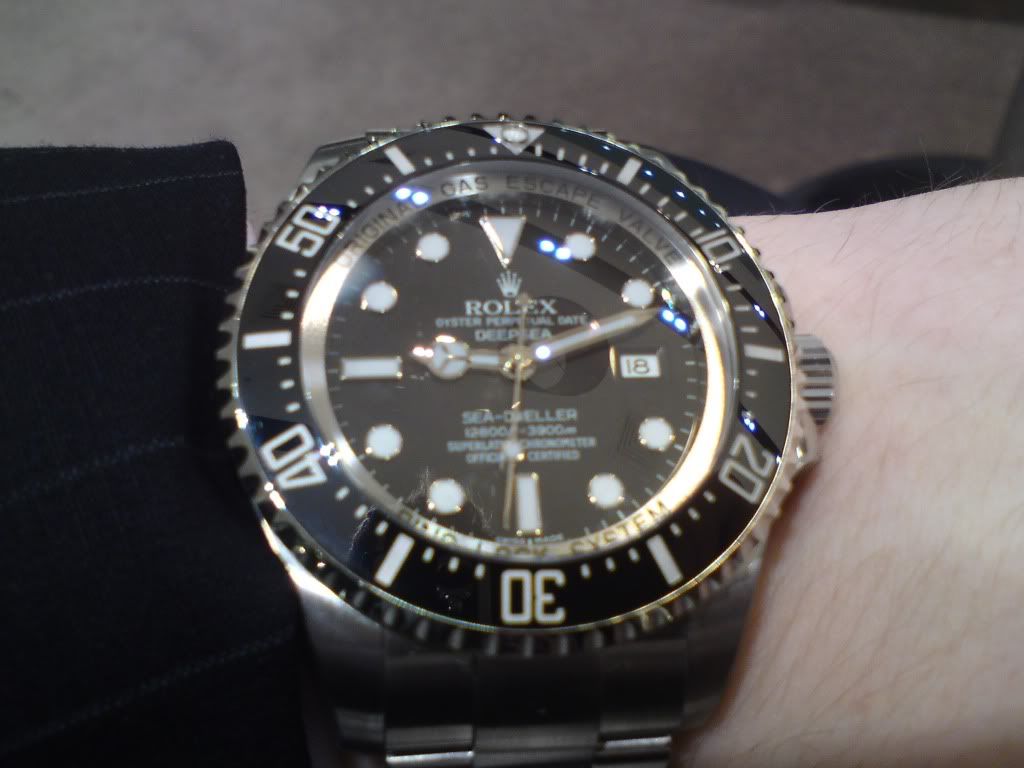
Rolex have carried on their traditional diver's watch look: black dial, black bezel, easy to read and easy to see at night. Simple yet functional. However, this really does have a premium feel to it, and I, for one, feel that it is a huge improvement in terms of quality over the previous generation Sea Dweller. The bezel has a lovely feel to it, and glides smoothly into place, and has a lovely shine to it. Wisely, Rolex have kept the bracelet brushed, with only the case and bracelet sides being polished. This, for me, really means it stamps out its tool watch credentials straight away - it's not attracting attention to itself by being flashy, it's here to do a job and do it well. I love the honesty of it.
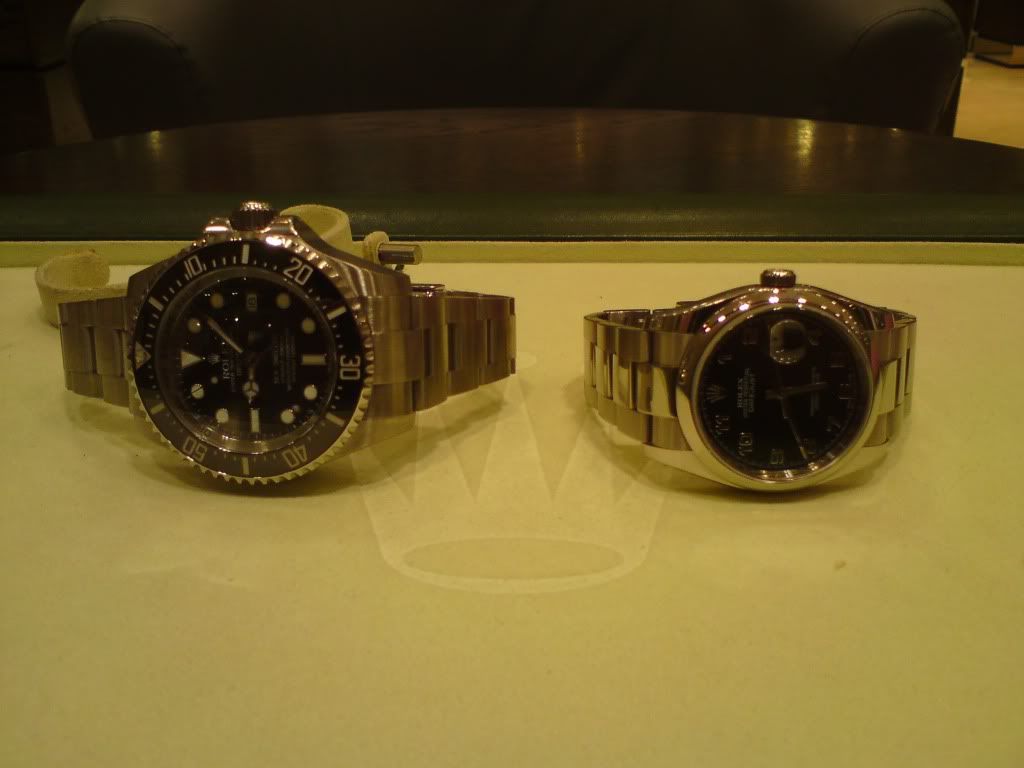
The size is a real "marmite" factor: some love the size of it, others hate it. In a world of Panerais, Breitlings and other oversized watches, 43mm for a case diameter is relatively modest. It's more the height of the watch which is an issue - I personally think it's just too tall for formal wear, there's no way of getting it comfortable under the cuff of a dress shirt. It absolutely dwarfs my Datejust:

However, it has the look of an industrial piece of engineering, it looks rough and ready to handle anything you could possibly throw at it. This is a watch crying out for outdoors activity, and I think that's the best place for it. In a business meeting, it'd look like a fish out of water, like a bodybuilder at a science fair. In it's element, however, it reigns supreme, and I'm sure the size and weight of it will give the wearer full confidence in it's abilities.

Practicality
As already mentioned above, this isn't the most practical of formal watches. Not something I'd personally recommend as an only watch, but if you had this in conjunction with a more suitable watch for work wear, then you have yourself what I think is a brilliant weekend watch. It's waterproof to a depth no human can physically dive to without a submersible, its brushed finish means scratches will be only a minor concern, the ceramic bezel is extremely durable, and the Glidelock clasp makes a particularly heavy and cumbersome watch surprisingly comfortable to wear. In fact, the Glidelock is such an important feature of the Deepsea, it needs a little section all to itself.

The Glidelock, for me, is the best practical innovation Rolex have developed in years. Whilst the Yachtmaster II's movement is a fantastic piece of horology, it's way out of reach for the average watch colector. The Glidelock, on the other hand, is a revolution in clasp adjustment, and won't just be available on the Deepsea, but the Submariner range as well: the new 18Ct and two tone models already have it, and the new steel version is expected to have it when launched too. Whilst ostensibly designed with wetsuits in mind (the diver's extension link remains with the Glidelock providing an extra 1.8cm of adjustment), it is the perfect feature for an ordinary user. Hot day? Let it out a notch or two. Want to play tennis? Tighten it up. The Glidelock removes the need to move pins in the clasp around - whilst you could get a high level of fine adjustment on the previous generation Sea Dweller, it was a fiddly, complicated and time consuming task compared to the Glidelock. To use it, simply undo the clasp, lift a finger under the edge (as pictured) and slide the link as much as you need. Takes all of 5 seconds. If I was the head of Rolex, I'd have that clasp placed on every single watch in the line up - my only criticism of the clasp is that it's only available on divers' models.
Value for Money
You certainly get a lot of watch for your money. Incredible engineering, high quality parts, bragging rights ("Oh, so your watch can go down to 300m? Nice, but look at mine..."), and that little bit of magic that will appeal to the 10 year old inside you. Of course, it's not a watch for everyone: its critics will cite its size and ostentatiousness as flaws, it'll be simply too much for most. But you need to look at this watch from Rolex's point of view, and I think they've been incredibly clever with this watch. Firstly, they needed a watch that could realistically compete in terms of chunkiness with Panerai and Breitling, and no one can argue that they haven't done that successfully. Secondly, they needed to reiterate their reputation as the makers of watches that can survive the harshest of places - the Deepsea is an excellent example of this, and testiment to their overengineering. Thirdly, they needed to underline their reputation as a maker of the highest quality sports watches, something that the (please forgive me) Submariner and Sea Dweller 4000 lacked. I see the Deepsea as a statement for Rolex's future, a reminder of what they do best. Yes, it's a big price increase compared to the old Sea Dweller, but this is in a completely different league. The Sea Dweller was an excellent watch for the 20th century, but the Deepsea is a 21st century watch through and through.
Conclusion
Excellent technical achievement, but not for everyone. Quite possibly the best engineered tool watch of all time, and truly the new benchmark in terms of sports watches.
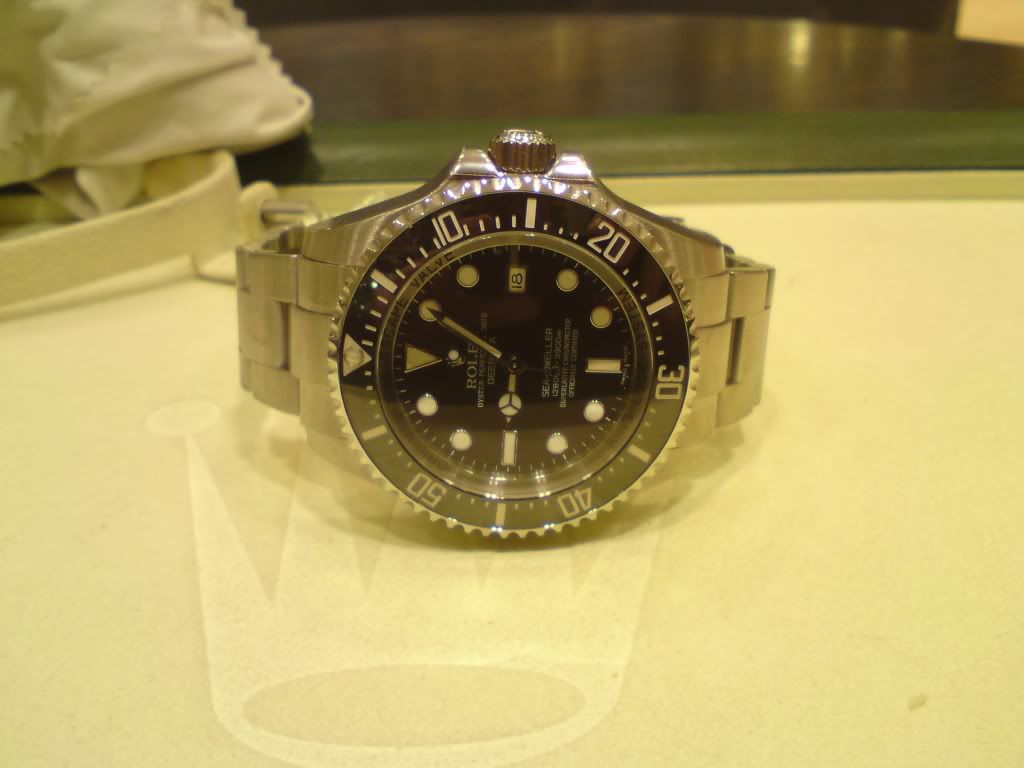
Techincal Details
*Model Number: 116660
*904L Stainless Steel
*43mm Case Diameter
*Unidirectional rotating diving bezel, ceramic bezel insert with platinum numerals
*Maxi Dial and Hands, filled with Chromalight luminous material
*Ringlock system for extra strength at depth
*Automatic Helium Escape Valve
*Domed Sapphire crystal
*Titanium Caseback
*Oyster bracelet with Glidelock clasp
*Oversized Triplock crown
*Waterproof to 3900m/12800ft
The Movement
*Cal. 3135
*Self windng chronometer
*28.8k bph
*Quickset date complication
*Parachrom blue hairspring and Paraflex shock absorber system
UK RRP: £5790
The Aesthetics
Rolex have carried on their traditional diver's watch look: black dial, black bezel, easy to read and easy to see at night. Simple yet functional. However, this really does have a premium feel to it, and I, for one, feel that it is a huge improvement in terms of quality over the previous generation Sea Dweller. The bezel has a lovely feel to it, and glides smoothly into place, and has a lovely shine to it. Wisely, Rolex have kept the bracelet brushed, with only the case and bracelet sides being polished. This, for me, really means it stamps out its tool watch credentials straight away - it's not attracting attention to itself by being flashy, it's here to do a job and do it well. I love the honesty of it.
The size is a real "marmite" factor: some love the size of it, others hate it. In a world of Panerais, Breitlings and other oversized watches, 43mm for a case diameter is relatively modest. It's more the height of the watch which is an issue - I personally think it's just too tall for formal wear, there's no way of getting it comfortable under the cuff of a dress shirt. It absolutely dwarfs my Datejust:
However, it has the look of an industrial piece of engineering, it looks rough and ready to handle anything you could possibly throw at it. This is a watch crying out for outdoors activity, and I think that's the best place for it. In a business meeting, it'd look like a fish out of water, like a bodybuilder at a science fair. In it's element, however, it reigns supreme, and I'm sure the size and weight of it will give the wearer full confidence in it's abilities.
Practicality
As already mentioned above, this isn't the most practical of formal watches. Not something I'd personally recommend as an only watch, but if you had this in conjunction with a more suitable watch for work wear, then you have yourself what I think is a brilliant weekend watch. It's waterproof to a depth no human can physically dive to without a submersible, its brushed finish means scratches will be only a minor concern, the ceramic bezel is extremely durable, and the Glidelock clasp makes a particularly heavy and cumbersome watch surprisingly comfortable to wear. In fact, the Glidelock is such an important feature of the Deepsea, it needs a little section all to itself.
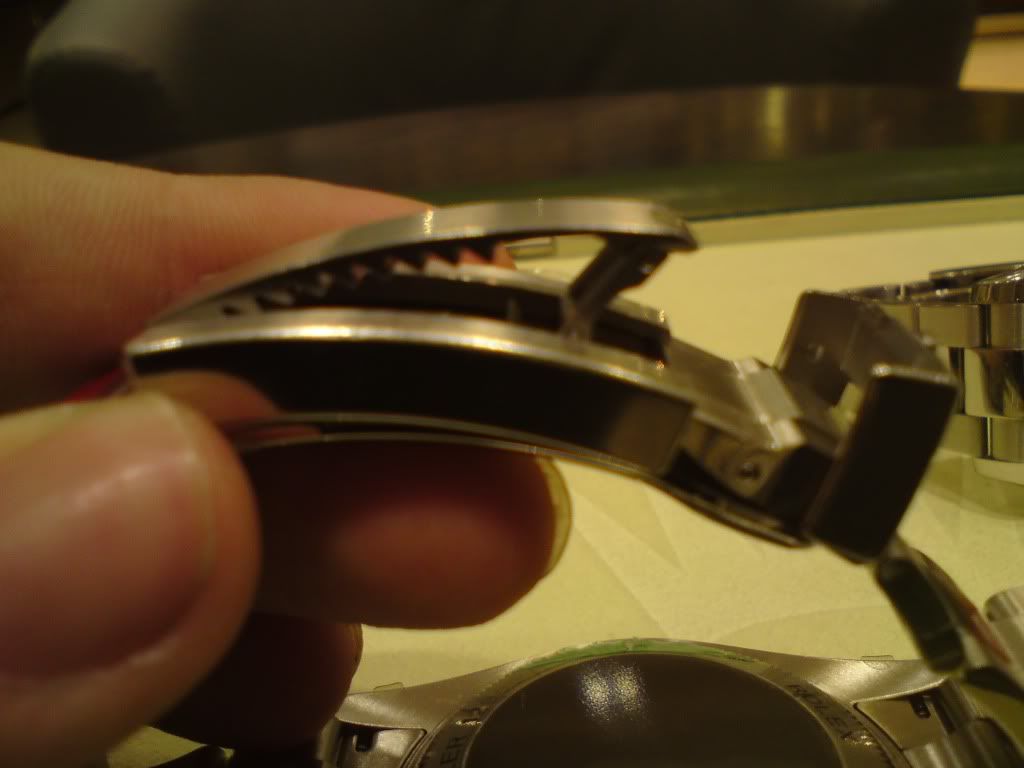
The Glidelock, for me, is the best practical innovation Rolex have developed in years. Whilst the Yachtmaster II's movement is a fantastic piece of horology, it's way out of reach for the average watch colector. The Glidelock, on the other hand, is a revolution in clasp adjustment, and won't just be available on the Deepsea, but the Submariner range as well: the new 18Ct and two tone models already have it, and the new steel version is expected to have it when launched too. Whilst ostensibly designed with wetsuits in mind (the diver's extension link remains with the Glidelock providing an extra 1.8cm of adjustment), it is the perfect feature for an ordinary user. Hot day? Let it out a notch or two. Want to play tennis? Tighten it up. The Glidelock removes the need to move pins in the clasp around - whilst you could get a high level of fine adjustment on the previous generation Sea Dweller, it was a fiddly, complicated and time consuming task compared to the Glidelock. To use it, simply undo the clasp, lift a finger under the edge (as pictured) and slide the link as much as you need. Takes all of 5 seconds. If I was the head of Rolex, I'd have that clasp placed on every single watch in the line up - my only criticism of the clasp is that it's only available on divers' models.
Value for Money
You certainly get a lot of watch for your money. Incredible engineering, high quality parts, bragging rights ("Oh, so your watch can go down to 300m? Nice, but look at mine..."), and that little bit of magic that will appeal to the 10 year old inside you. Of course, it's not a watch for everyone: its critics will cite its size and ostentatiousness as flaws, it'll be simply too much for most. But you need to look at this watch from Rolex's point of view, and I think they've been incredibly clever with this watch. Firstly, they needed a watch that could realistically compete in terms of chunkiness with Panerai and Breitling, and no one can argue that they haven't done that successfully. Secondly, they needed to reiterate their reputation as the makers of watches that can survive the harshest of places - the Deepsea is an excellent example of this, and testiment to their overengineering. Thirdly, they needed to underline their reputation as a maker of the highest quality sports watches, something that the (please forgive me) Submariner and Sea Dweller 4000 lacked. I see the Deepsea as a statement for Rolex's future, a reminder of what they do best. Yes, it's a big price increase compared to the old Sea Dweller, but this is in a completely different league. The Sea Dweller was an excellent watch for the 20th century, but the Deepsea is a 21st century watch through and through.
Conclusion
Excellent technical achievement, but not for everyone. Quite possibly the best engineered tool watch of all time, and truly the new benchmark in terms of sports watches.
Wednesday, 9 September 2009
Daytona Update
Well, it's official, I've decided to remove myself from the Daytona waiting list. For me, at least, the love affair with the most sought-after watch in the world is over. I've just come to the conclusion that too many people have one these days, and I've never been one to follow the crowd. The GMT IIc is definitely my new mistress.
Thanks
The GMT Master
Thanks
The GMT Master
Tuesday, 4 August 2009
The Rolex GMT-Master IIc
I thought it was high time to scribble a few words about the watch that inspired my username: The GMT Master, specifically the current GMT IIc, first launched in 2005. I think this is a truly special watch, and, for me, sums up perfectly what a modern Rolex should be: robust, practical, and at the cutting edge of technology.

The History
For those of you not familiar with the roots of the GMT-Master, it has a really nice story about how it came into being. The original GMT was commissioned by head of Pan-Am Juan Trippe in 1955, due to a need for his air crew to have a time piece that could display two different time zones. Rolex obliged, and came up with a modified version of the original Turn-O-Graph, featuring the iconic blue and red "Pepsi" bezel, and a modified movement with an added 24 hour hand and date wheel. A very simple solution that resulted in a watch that is firmly embedded in the hearts of every Rolex enthusiast. Interestingly, Rolex also made a white-dialled version of the 6542 for Pan-Am management, as the watches intended for crew members had been finding their ways onto the wrists of the office workers. In any case, the GMT-Master has been refined and changed over the years, with the biggest change coming in around 1983 when the GMT-Master II was launched. This introduced an independent hours hand, meaning you can set the watch to display 3 different time zones (standard hour hand to local time, bezel to time zone 1, 24 hour hand to time zone 2). The most recent GMT II, ref. 116710/116713/116718 for the steel, two tone and 18ct models respectively was first introduced at Basel in 2005, with all models becoming available by the third quarter of 2007.
(Information taken from fiftyfathoms.net's excellent article on the 6542)
Model Features
The current model features a raft of updates from the previous generation, including:
"Maxi" case and dial (bigger case lugs, bigger dial indicies)
Fat hands
Cerachrom ceramic bezel with Platinum or 18Ct Gold numerals
New solid centre link bracelet, with polished centre links
Updated Fliplock clasp with Easylink half extension
Cal. 3186 movement, with Parachrom Blue hairspring and Paraflex shock resisters
The Comparison
Compared to the previous generation of GMT IIs (16710/16713/16718), it feels like a much more solid watch. There's a noticeable weight increase (no bad thing, in my opinion), and the watch appears bigger on the wrist, despite remaining at a conservative 40mm case diameter. The bezel looks fantastic, although it is a shame that Rolex haven't released a "pepsi" coloured bezel to date - apparently, it's proving very difficult to produce a ceramic bezel with those two colours in one complete piece, but I'm certain that Rolex are working hard on it. If it can be done, it will. As well as this, the previous 120 click bezel has been replaced by a 24 click one, which makes for a very smooth bezel movement, but lacks some of the fine accuracy that certain people enjoyed on the previous generation.
The Competition
Whilst rival brands such as Omega, Breitling, Panerai and Cartier all do GMT variations of their watches, none of them have the rich history of the GMT-Master. The stylings of the Rolex might not be to everyones' tastes, and I'm certain that some would prefer to have one from another brand: perhaps the bold looks of the PAM 297, or the ruggedness of the Breitling Colt GMT. But me, I'd go for the assured simplicity of the GMT IIc every time - I think this is the best watch Rolex has to offer at the moment in terms of looks, durability and practicality.
My recommendation: for every day practicality, the steel 116710. If you can live the the softness of gold, get the steel and 18Ct 116713 - by far the best two tone watch Rolex produces.
Thanks for reading
The GMT Master

The History
For those of you not familiar with the roots of the GMT-Master, it has a really nice story about how it came into being. The original GMT was commissioned by head of Pan-Am Juan Trippe in 1955, due to a need for his air crew to have a time piece that could display two different time zones. Rolex obliged, and came up with a modified version of the original Turn-O-Graph, featuring the iconic blue and red "Pepsi" bezel, and a modified movement with an added 24 hour hand and date wheel. A very simple solution that resulted in a watch that is firmly embedded in the hearts of every Rolex enthusiast. Interestingly, Rolex also made a white-dialled version of the 6542 for Pan-Am management, as the watches intended for crew members had been finding their ways onto the wrists of the office workers. In any case, the GMT-Master has been refined and changed over the years, with the biggest change coming in around 1983 when the GMT-Master II was launched. This introduced an independent hours hand, meaning you can set the watch to display 3 different time zones (standard hour hand to local time, bezel to time zone 1, 24 hour hand to time zone 2). The most recent GMT II, ref. 116710/116713/116718 for the steel, two tone and 18ct models respectively was first introduced at Basel in 2005, with all models becoming available by the third quarter of 2007.
(Information taken from fiftyfathoms.net's excellent article on the 6542)
Model Features
The current model features a raft of updates from the previous generation, including:
"Maxi" case and dial (bigger case lugs, bigger dial indicies)
Fat hands
Cerachrom ceramic bezel with Platinum or 18Ct Gold numerals
New solid centre link bracelet, with polished centre links
Updated Fliplock clasp with Easylink half extension
Cal. 3186 movement, with Parachrom Blue hairspring and Paraflex shock resisters
The Comparison
Compared to the previous generation of GMT IIs (16710/16713/16718), it feels like a much more solid watch. There's a noticeable weight increase (no bad thing, in my opinion), and the watch appears bigger on the wrist, despite remaining at a conservative 40mm case diameter. The bezel looks fantastic, although it is a shame that Rolex haven't released a "pepsi" coloured bezel to date - apparently, it's proving very difficult to produce a ceramic bezel with those two colours in one complete piece, but I'm certain that Rolex are working hard on it. If it can be done, it will. As well as this, the previous 120 click bezel has been replaced by a 24 click one, which makes for a very smooth bezel movement, but lacks some of the fine accuracy that certain people enjoyed on the previous generation.
The Competition
Whilst rival brands such as Omega, Breitling, Panerai and Cartier all do GMT variations of their watches, none of them have the rich history of the GMT-Master. The stylings of the Rolex might not be to everyones' tastes, and I'm certain that some would prefer to have one from another brand: perhaps the bold looks of the PAM 297, or the ruggedness of the Breitling Colt GMT. But me, I'd go for the assured simplicity of the GMT IIc every time - I think this is the best watch Rolex has to offer at the moment in terms of looks, durability and practicality.
My recommendation: for every day practicality, the steel 116710. If you can live the the softness of gold, get the steel and 18Ct 116713 - by far the best two tone watch Rolex produces.
Thanks for reading
The GMT Master
Monday, 20 July 2009
Rolex Daytona: Worth It?
One watch that is always holds a deal of aura about it is the Rolex Daytona, and not a week goes by at the shop where I'm not asked about it. So, for the uninitiated, I'll take a few moments to explain what it is, and why it's so revered in the watch world.
The current Daytona comes in three basic forms: in stainless steel, in steel and 18Ct yellow gold and 18Ct gold (yellow, white and rose). It's a chronograph watch (a watch with a stopwatch function), comes on either the Oyster bracelet or a leather strap (only on the 18Ct models), and is quite a good looking watch by anyone's standards. The steel model starts at £6170, the two tone at just under the £9000 mark, the 18Ct models go for £19000, and if you want added diamonds and the like, the price keeps going up and up. However, the steel one is the one I'm going to focus on, as it is this one that is the Daytona.
The steel Daytona, ref. 116520, has a reputation as one of the hardest watches to buy new in the world. It's not due to the cost, but rather the huge waiting lists. I'm currently 40th on the waiting list at the shop, and at the current rate of Daytonas coming into stock, I have another 9 years to wait. Wherever you go in the UK, you'll get told there's a huge waiting list, and I don't know how many people I've seen walk out dejected when I tell them this. For the casual observer, there's nothing too fancy about it: it has an excellent movement inside it (the cal. 4130), but doesn't have features that you can't find on any other number of luxury watches. I can appreciate that the hype is a little bewildering, but I now have to put on my historian's hat to explain it all for you.
Let's cut back to the 1960s - insert whatever nostalgic recollections or conceptions you have here - and find a watch. The one we're after is the original Daytona, the ref. 6241 in particular.

If we were to ask the manager of the Rolex dealership how well this Daytona was selling, he's probably respond that it was a complete dead weight. Zero popularity, and highly unloved. Now we need to fast forward to Italy in the 1980s, which is where Daytona-mania really took off. All it needed was to be featured on the front page of an Italian fashion magazine to spark a rush to snap up this watch, especially that with the fabled "Paul Newman" exotic dial, as shown in the above picture. The desire for the Daytona spread around the world, with vintage pieces commanding huge prices at auction, and current models flying out of dealerships like proverbial hot cakes. The Daytona had become an icon.
Prices today, even with the recent financial crisis, still remain high - not so long ago, a 6241 sold at auction for a staggering Aus$80000. Let me remind you that this was for a 40 year old, steel manual wind chronograph, with a notoriously dodgy bracelet. Don't get me wrong, it's a lovely looking watch, but it's silly money for what it is. It doesn't even have an in-house Rolex movement, it uses a Valjoux 72 movement instead.
So let me get back to the current model: whilst it's difficult to get hold of brand new, it'll never be a collector's piece - it is, these days, a relatively common watch. You don't have to look too hard to find someone wearing one - Sir Alan Sugar, numerous football players, your run of the mill businessman, they'll have one strapped to their wrist. I think the thrill of getting a Daytona is trying to track one down - although I'm on the list for one, I'm not even sure if I want one any more. I think Rolex have better watches in their line up for less than the £6170 asking price of the Daytona, and I'd definitely want to look at those before a Daytona.
Then we have the prickly problem of the Daytona's biggest rival (at least in my eyes): The Omega Speedmaster Professional. There are plenty of similarities between the two: both launched at around the same time (the Speedy in 1957, the Daytona a couple of years after), both used manual wind movements, even aesthetically they were quite similar.

What's so special about this watch? The Speedmaster is the first and only watch worn on the moon, as well as the only watch that was NASA flight certified. When NASA were testing several chronographs for the Apollo programme, the Speedmaster was the only one that could withstand every single test thrown at it, beating several other chronographs, including the Rolex Daytona. Whilst vintage pieces do fetch handsome prices these days, the current model (pretty much the same watch as you could buy 40 years ago, albeit with a different manual wind movement and a much improved bracelet) is nowhere near as popular as the Daytona. It's a quarter of the price of a Daytona as well: you can walk away with a brand new Speedy Pro for £2090 retail, plus a little bit of discount too.
So, to get back to my original question, is the Rolex Daytona worth it? Well, for many it has a glittering alure, and I can see where they come from. I just personally think there are watches with more interesting backgrounds that can be had for a lot lot less, without the wait. If you buy a Daytona, you'll be getting a great watch in it's own right, but I often feel that the hype is a little unjustified.
The current Daytona comes in three basic forms: in stainless steel, in steel and 18Ct yellow gold and 18Ct gold (yellow, white and rose). It's a chronograph watch (a watch with a stopwatch function), comes on either the Oyster bracelet or a leather strap (only on the 18Ct models), and is quite a good looking watch by anyone's standards.
 The steel model starts at £6170, the two tone at just under the £9000 mark, the 18Ct models go for £19000, and if you want added diamonds and the like, the price keeps going up and up. However, the steel one is the one I'm going to focus on, as it is this one that is the Daytona.
The steel Daytona, ref. 116520, has a reputation as one of the hardest watches to buy new in the world. It's not due to the cost, but rather the huge waiting lists. I'm currently 40th on the waiting list at the shop, and at the current rate of Daytonas coming into stock, I have another 9 years to wait. Wherever you go in the UK, you'll get told there's a huge waiting list, and I don't know how many people I've seen walk out dejected when I tell them this. For the casual observer, there's nothing too fancy about it: it has an excellent movement inside it (the cal. 4130), but doesn't have features that you can't find on any other number of luxury watches. I can appreciate that the hype is a little bewildering, but I now have to put on my historian's hat to explain it all for you.
Let's cut back to the 1960s - insert whatever nostalgic recollections or conceptions you have here - and find a watch. The one we're after is the original Daytona, the ref. 6241 in particular.
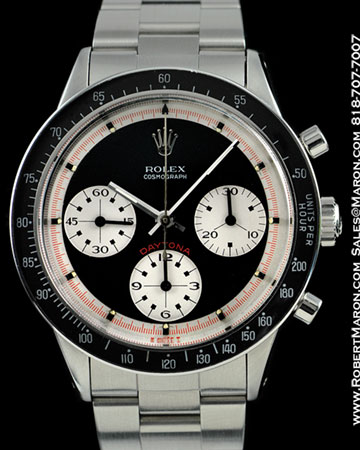
If we were to ask the manager of the Rolex dealership how well this Daytona was selling, he's probably respond that it was a complete dead weight. Zero popularity, and highly unloved. Now we need to fast forward to Italy in the 1980s, which is where Daytona-mania really took off. All it needed was to be featured on the front page of an Italian fashion magazine to spark a rush to snap up this watch, especially that with the fabled "Paul Newman" exotic dial, as shown in the above picture. The desire for the Daytona spread around the world, with vintage pieces commanding huge prices at auction, and current models flying out of dealerships like proverbial hot cakes. The Daytona had become an icon.
Prices today, even with the recent financial crisis, still remain high - not so long ago, a 6241 sold at auction for a staggering Aus$80000. Let me remind you that this was for a 40 year old, steel manual wind chronograph, with a notoriously dodgy bracelet. Don't get me wrong, it's a lovely looking watch, but it's silly money for what it is. It doesn't even have an in-house Rolex movement, it uses a Valjoux 72 movement instead.
So let me get back to the current model: whilst it's difficult to get hold of brand new, it'll never be a collector's piece - it is, these days, a relatively common watch. You don't have to look too hard to find someone wearing one - Sir Alan Sugar, numerous football players, your run of the mill businessman, they'll have one strapped to their wrist. I think the thrill of getting a Daytona is trying to track one down - although I'm on the list for one, I'm not even sure if I want one any more. I think Rolex have better watches in their line up for less than the £6170 asking price of the Daytona, and I'd definitely want to look at those before a Daytona.
Then we have the prickly problem of the Daytona's biggest rival (at least in my eyes): The Omega Speedmaster Professional. There are plenty of similarities between the two: both launched at around the same time (the Speedy in 1957, the Daytona a couple of years after), both used manual wind movements, even aesthetically they were quite similar.

What's so special about this watch? The Speedmaster is the first and only watch worn on the moon, as well as the only watch that was NASA flight certified. When NASA were testing several chronographs for the Apollo programme, the Speedmaster was the only one that could withstand every single test thrown at it, beating several other chronographs, including the Rolex Daytona. Whilst vintage pieces do fetch handsome prices these days, the current model (pretty much the same watch as you could buy 40 years ago, albeit with a different manual wind movement and a much improved bracelet) is nowhere near as popular as the Daytona. It's a quarter of the price of a Daytona as well: you can walk away with a brand new Speedy Pro for £2090 retail, plus a little bit of discount too.
So, to get back to my original question, is the Rolex Daytona worth it? Well, for many it has a glittering alure, and I can see where they come from. I just personally think there are watches with more interesting backgrounds that can be had for a lot lot less, without the wait. If you buy a Daytona, you'll be getting a great watch in it's own right, but I often feel that the hype is a little unjustified.
Time to make a start
Well, this is my first foray into the world of blogging. Whether this'll keep me occupied for long or not remains to be seen, but whilst this does hold my attention, I aim to write some vaguely interesting and possibly witty lines about watches, my thoughts on them, and what they mean to me.
Firstly, a little background information about me. I'm British, fortunate enough to work in an excellent watch shop, and have a passion for all things horological. I'm a huge fan of Rolex and Omega, and as much as I love the mid to high end of the market, I also like honest, well made entry level watches as well, especially brands like Rotary and Citizen. I don't think I've ever had much choice in liking watches - I was pretty much raised in a watch shop, and from an early age, I found timepieces fascinating, with my Dad commenting that I was a "clock-obsessed toddler." Apparently I kept a close eye on the stock, and would be able to know exactly which ones had been sold. However, my passion had remained fairly dormant up until about two years ago when I got my first job at the local Rolex dealership, which sparked off a drive to learn more about watches and how they work. I've learnt from both the managers of the shop, as well as the fine community at www.rolexforums.com - hell, I've learnt nuggets of information that people who have been in the jewellery industry for close to 30 years didn't know. I've been able to pick up a great deal of information in a very short period of time, and I have some fairly solid opinions on what I like and don't like.
Anyway, I'm a fairly strong believer in the notion that you can tell a lot about a person by the watch they wear: perhaps you'll come to your own conclusions about myself and my collection as well. I have a rather modest selection of watches for the time being, but they are my pride and joy.
The first one, and the centrepiece of my collection is my Rolex Datejust 116200 - stainless steel, self winding chronometer rated movement, Oyster bracelet, polished steel bezel and a black arabic dial. Has a nice weight to it, measures in with a case diameter of 36mm, and has a classic look with a contemporary twist. People often have strong opinions when it comes to Rolex, as well as a lot of preconceptions, but I think this watch is as far away from the flashy, gaudy, impractical watch that people often think of when the word "Rolex" is mentioned. Here it is:

Pretty, no?
The other two watches in my possession are both Rotary chronographs, one in similar style to the Rolex Daytona, and the other in the style of a Breitling Navitimer. I got both of these for less than £100 each, and for the money, I challenge you to find a better watch in terms of looks, prestiege and quality. I'm currently wearing the leather strapped one as my daily beater - there's nothing more comfortable than a leather strapped watch on a hot summer's day.


Thanks for reading, and I hope you enjoy the future articles I write.
Much love
The GMT Master
Firstly, a little background information about me. I'm British, fortunate enough to work in an excellent watch shop, and have a passion for all things horological. I'm a huge fan of Rolex and Omega, and as much as I love the mid to high end of the market, I also like honest, well made entry level watches as well, especially brands like Rotary and Citizen. I don't think I've ever had much choice in liking watches - I was pretty much raised in a watch shop, and from an early age, I found timepieces fascinating, with my Dad commenting that I was a "clock-obsessed toddler." Apparently I kept a close eye on the stock, and would be able to know exactly which ones had been sold. However, my passion had remained fairly dormant up until about two years ago when I got my first job at the local Rolex dealership, which sparked off a drive to learn more about watches and how they work. I've learnt from both the managers of the shop, as well as the fine community at www.rolexforums.com - hell, I've learnt nuggets of information that people who have been in the jewellery industry for close to 30 years didn't know. I've been able to pick up a great deal of information in a very short period of time, and I have some fairly solid opinions on what I like and don't like.
Anyway, I'm a fairly strong believer in the notion that you can tell a lot about a person by the watch they wear: perhaps you'll come to your own conclusions about myself and my collection as well. I have a rather modest selection of watches for the time being, but they are my pride and joy.
The first one, and the centrepiece of my collection is my Rolex Datejust 116200 - stainless steel, self winding chronometer rated movement, Oyster bracelet, polished steel bezel and a black arabic dial. Has a nice weight to it, measures in with a case diameter of 36mm, and has a classic look with a contemporary twist. People often have strong opinions when it comes to Rolex, as well as a lot of preconceptions, but I think this watch is as far away from the flashy, gaudy, impractical watch that people often think of when the word "Rolex" is mentioned. Here it is:

Pretty, no?
The other two watches in my possession are both Rotary chronographs, one in similar style to the Rolex Daytona, and the other in the style of a Breitling Navitimer. I got both of these for less than £100 each, and for the money, I challenge you to find a better watch in terms of looks, prestiege and quality. I'm currently wearing the leather strapped one as my daily beater - there's nothing more comfortable than a leather strapped watch on a hot summer's day.


Thanks for reading, and I hope you enjoy the future articles I write.
Much love
The GMT Master
Subscribe to:
Posts (Atom)
