Showing posts with label Positive. Show all posts

Saturday, 29 May 2010

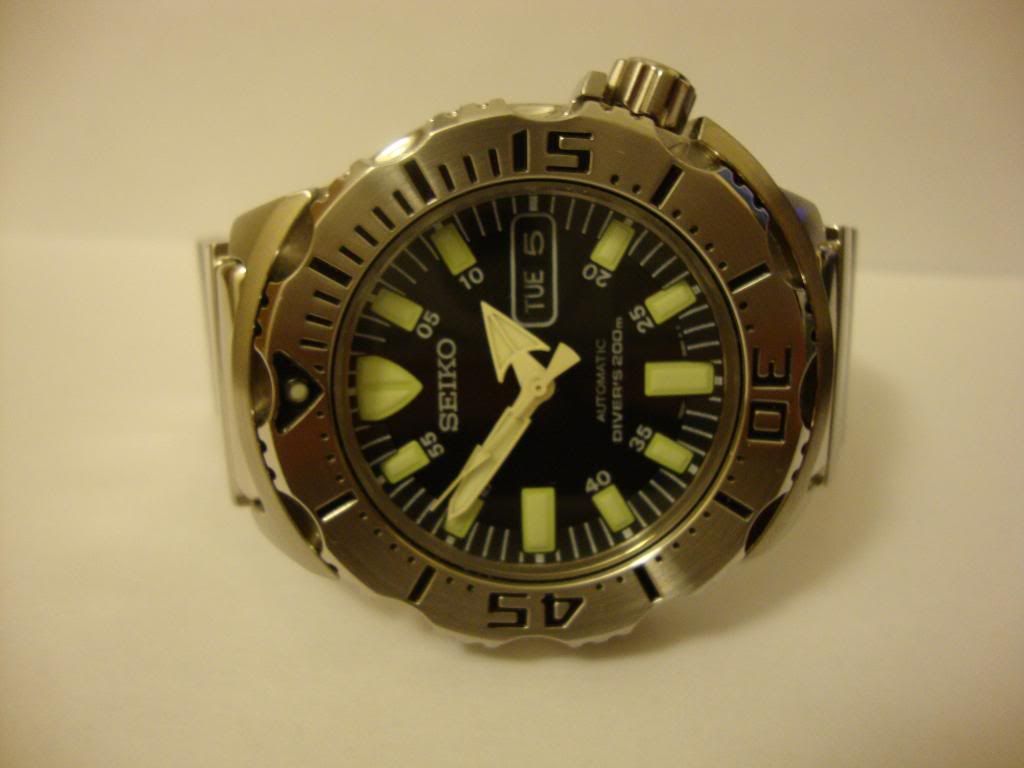
Seiko Black Monster Review

As opposed to the usual array of luxury watches I review, I feel compelled to write down my thoughts on what I believe might just be the best value automatic diver's watch in the world. This is a watch that punches far above its weight, and makes similarly priced watches feel poor quality and overpriced by comparison. For me, the Monster is the new Diving Watch yardstick - I now compare all other divers to it.


Technical Features

*Model Ref: SKX779
*Stainless steel case
*Unidirectional rotating diving bezel w/ 60 minute graduations and glowing bezel pearl
*Case diameter: 42mm
*Black dial with Lumibrite baton markers, and luminous hands
*Screwdown crown @ 4 o'clock
*Hardlex Crystal
*200m Waterproofing

The Movement

In a nutshell, it's a non-hacking automatic movement with day and date complications - John Davis' review here is an authoritative walkthrough of the movement, and describes it much better than I could. In terms of accuracy, it's not too bad - mine gains roughly 8 seconds per day

UK RRP: Not sold here, eBay prices tend to lie around £150-180.

The Aesthetics

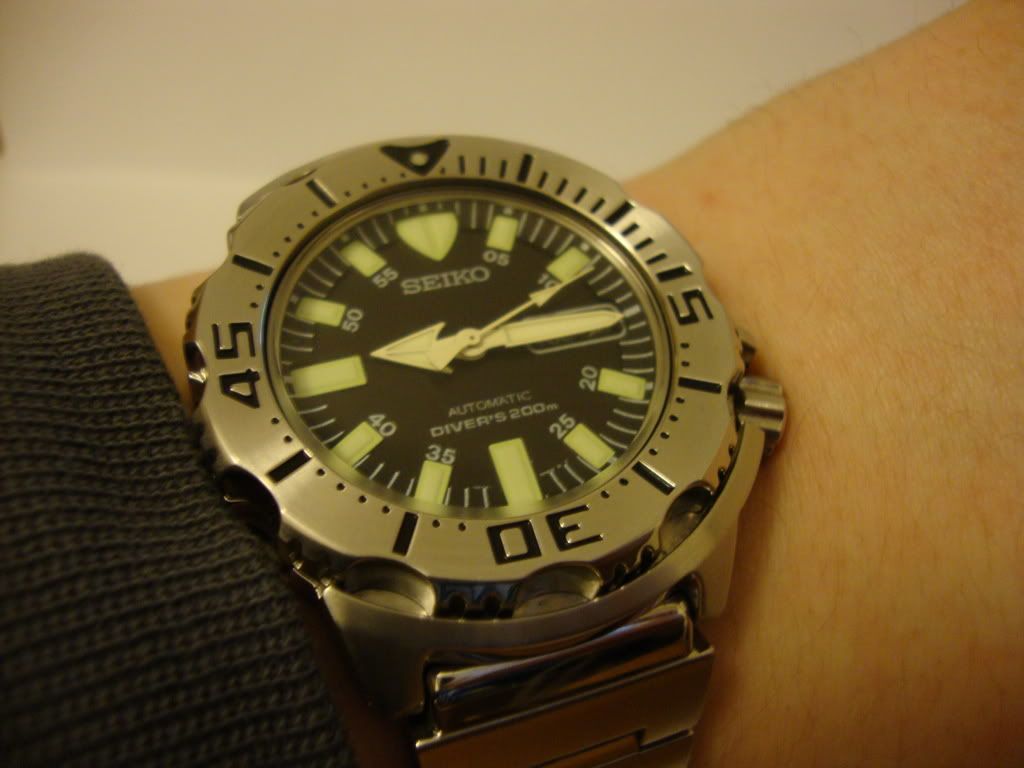
There's no denying the fact that this is a bold watch - but it does so in a way that befits it's purpose as a serious diver's watch. This watch looks purposeful, honest in its intentions, and I can only admire that in a watch. It's substantial without being overly thick, and sits well on the wrist. Simplicity in the dial, and a large, legible bezel makes it practical for every day use, particularly at night. I can't compliment enough the lume on this watch - it blows anything I've seen personally out of the water. Rolex and Omega are improving their lumes, but for intensity and longevity, no non-radiactive paint compounds can compare. It takes very little to charge it, and even on low light exposure, it can store enough power to be legible in the dark for several hours.

The bracelet is nicely finished - mainly brushed with polished highlights, and it's not trying to imitate another brand, which is always an issue at this price point. It's a little fiddly to adjust, but nothing impossible by any means. The clasp is also very impressive - a foldover push button deployment with a locking clip makes for a very solid and secure fit. However, it should be noted that I have had some problems with the locking clip popping open under stress, though the rest of the clasp remains secure - I believe this is because I need to loosen the clasp a little on account of the warmer weather, so this is by no means a major problem


The Feel

As some of you may have worked out by now, I like a substantial watch. This doesn't disappoint - the bracelet links are solid, and they don't skimp on the construction of the case. It's not as heavy as a Deepsea, for example, but it lies at a similar weight, at a guess, as a Seamaster 300m. When properly adjusted, it sits securely on the wrist, and is best with a little movement from the head. I haven't got the world's largest wrists (usually need 1 or 2 links out of most watches), but it doesn't look oversized at all. I think this can be partially attributed to the large bezel, which reduces the dial size to a reasonable level. This certainly doesn't feel as flimsy as a lot of watches at this price point, and I'd argue feels nicer than a lot of watches worth 10 or even 20 times more. It really is an understated hero, and it's a shame that more people don't know about it.

Practicality

I see this as a great daily beater. You can wear it with confidence, and treat it with as little respect as you want, and it'll still keep ticking. Certainly a good idea if you don't want you multiple thousand pound watch getting messed up too badly. Not one for wearing with a suit, but for just about anything else, it'll do its job admirably

Conclusion

I really love this watch, it has so much to offer for such a small price. It having an automatic movement is, for many WISes, a notable plus point, and I feel it is a breath of fresh air from the soulless quartz watches that dominate this segment of the market. Unique styling is a major benefit, and I also see it as a conversation starter. It's eyecatching in a good way, and it has the engineering quality to back it up as well. If you are looking for a cheaper everyday watch, look no further - it may have a couple of minor niggles (the non-hacking movement for one), but it makes up for this with oodles of character and usefulness. Throw away your quartz watches, and embrace the Monster!
Saturday, 16 January 2010

Rolex Datejust II - Review

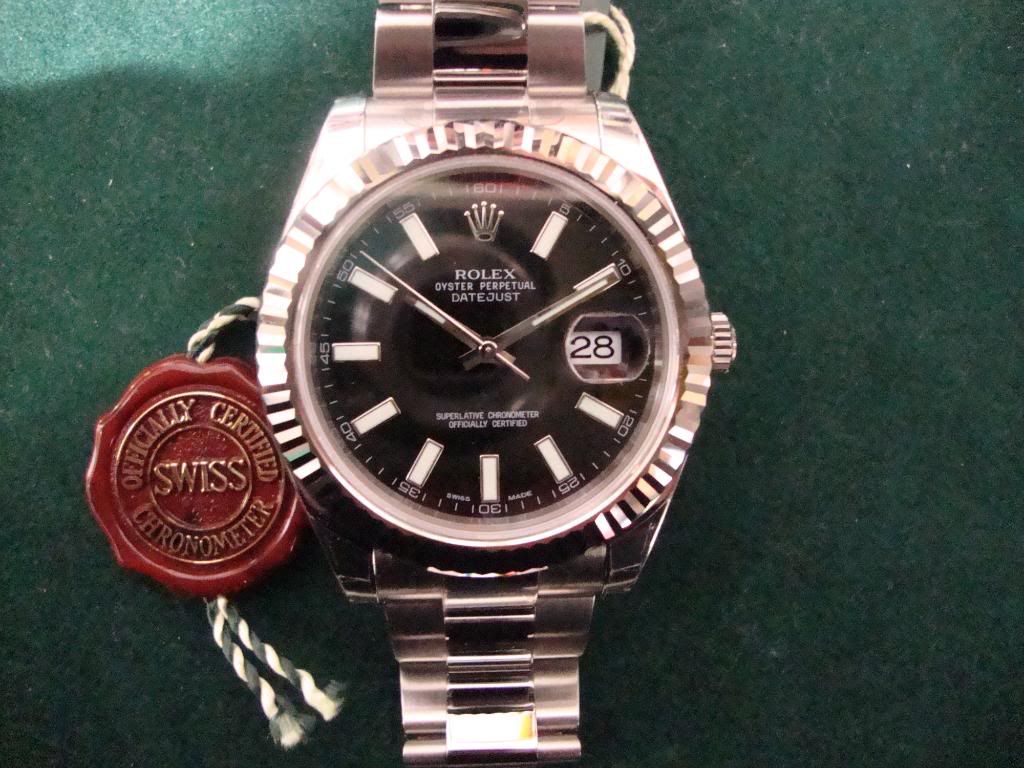
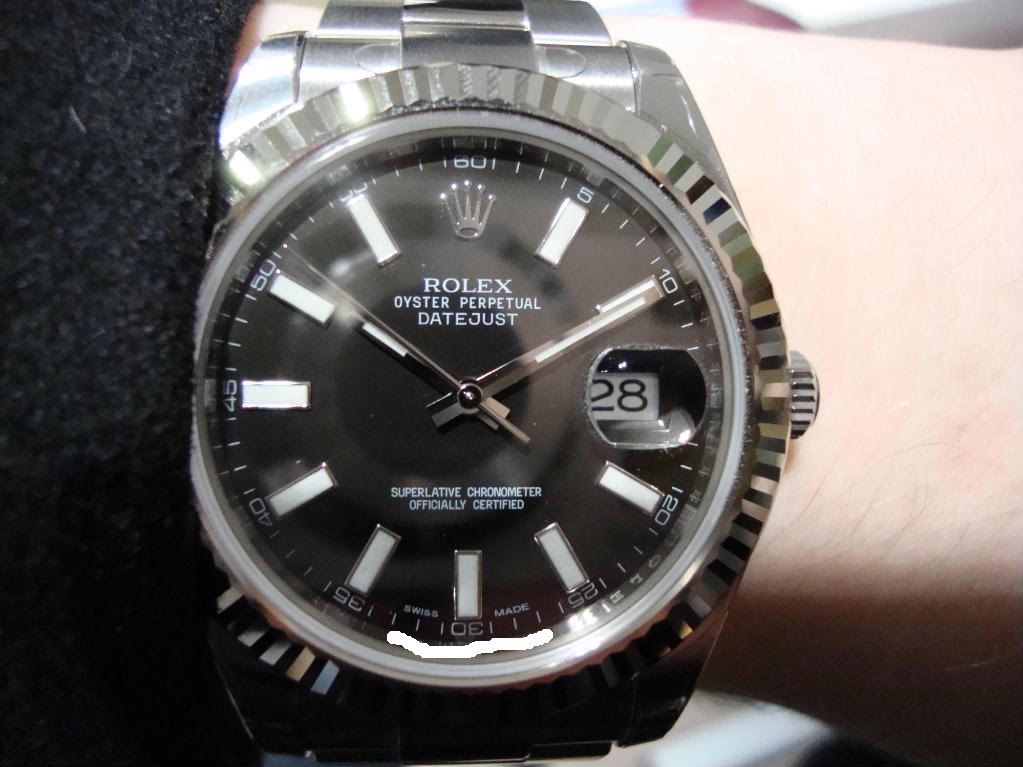
The Datejust II is the latest update to the long serving Datejust range, and this is arguably the most radical interpretation of the classic date watch that Rolex have ever done. It has a large size increase over the standard gent's Datejust, and is certainly a striking piece to look at. As such, the watch has divided opinion, with some arguing that it is simply too big to be a dress watch. On the other hand, it has turned what many perceive as a watch for the older man into very much a younger man's watch, and is certainly an interesting addition to the big watch parade. This article will assess features, looks, wearability and build quality, with a few pictures along the way. The model reviewed is the steel and 18Ct white gold model.


Technical Features

*Model number: 166334
*904 L steel case and bracelet
*18ct White Gold Fluted bezel
*Case Diameter: 41mm
*Choice of dials, model reviewed - Black baton dial, w/ luminous hands and markers, arabics around the circumference
*Twinlock crown
*Sapphire crystal w/ cyclops date magnifier (Antireflective coating on underside of cyclops)
*Oyster bracelet with Oysterclasp
*Waterproof 100m/330Ft

The Movement

*Cal. 3136 (exclusive to the Datejust II)
*28.8k BPH
*Self-winding, chronometer rated
*Quickset date complication
*Parachrom blue hairspring, Paraflex shock absorbers

UK RRP: £4940

The Aesthetics

The two most striking aspects about this watch is how big it seems, and how prominent the bezel is. Although the case diameter is essentially the same as, say, a Submariner or a GMT IIc, it appears larger than them placed side by side. I believe this is largely due to the size of the dial - with the bezel being thinner than the rotating ones on the sports models, the dial stretches further, which gives the appearance of a larger surface area on the wrist. That's not to say that the bezel is a shrinking violet - far from it. The dial to bezel ratios are more biased towards the bezel than on the 36mm equivalent (ref. 116234), making it really sparkle. Some people have expressed that they think it's too prominent, but I disagree - if it was any thinner, it would mean the dial would be even larger, and would make the watch begin to look odd on the wrist. You really need to see the bezel and the way it catches the light to appreciate it - it truly is a thing of beauty.

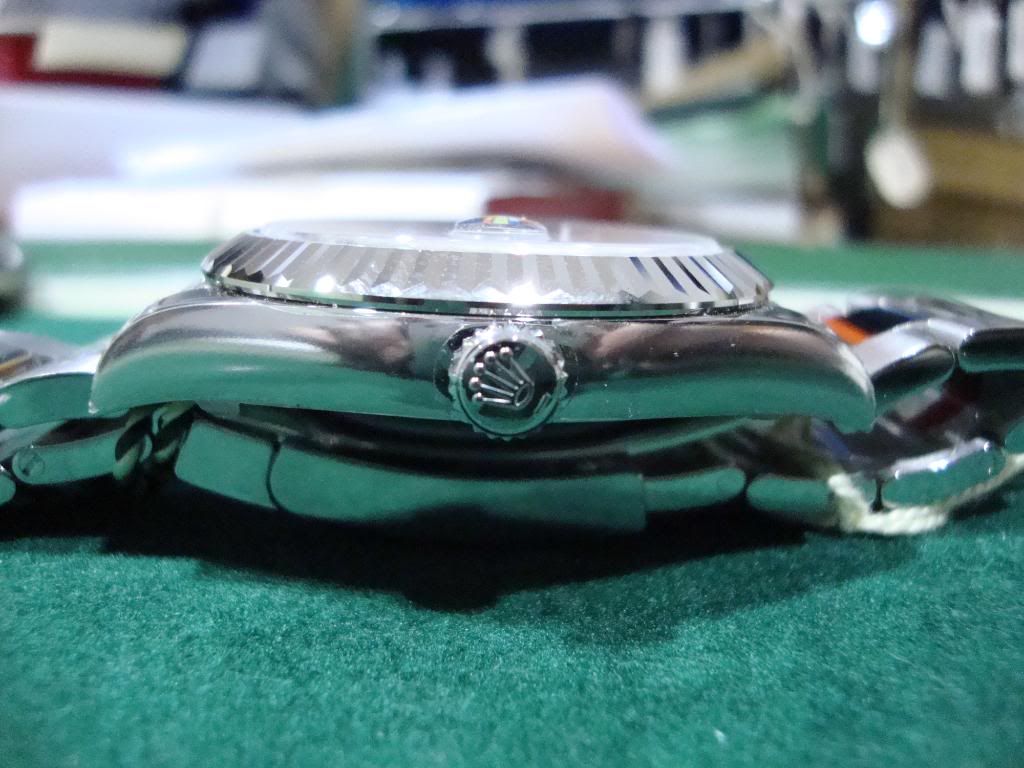
Another aspect of note is the size of the crown in relation to the watch. Rolex have decided to utilise the Twinlock crown on the Datejust II, the same as on the 36mm model. Whilst it looks spot on on the smaller watch, it seems a little disproportionate on a 41mm case. In a similar way to how they upgraded the crown on the GMT IIc to the Triplock, they probably should have done the same on the Datejust II. Finally, despite the large case diameter, the thickness of the watch is quite reasonable, which should mean it'll still fit nicely under a shirt cuff.


Practicality


I think this watch is a great addition to the range for those who want a smart looking dress watch that's a bit more substantial. I know I have small wrists, and the 36mm Datejust looks pretty good on me, but for men with larger wrists, it might not look right. Yes, it's a step away from classic Rolex sizing, but there's nothing wrong with offering more choice. People are wearing far bigger watches these days, with 45 and 50mm watches becoming more and more popular. In any case, the Datejust II isn't as radical as some would make out, and it is certainly more wearable than a lot of other oversize watches. Crucially, unlike the Deepsea, the thickness of the watch is reasonable, and that's the killer aspect when it comes to wearability.

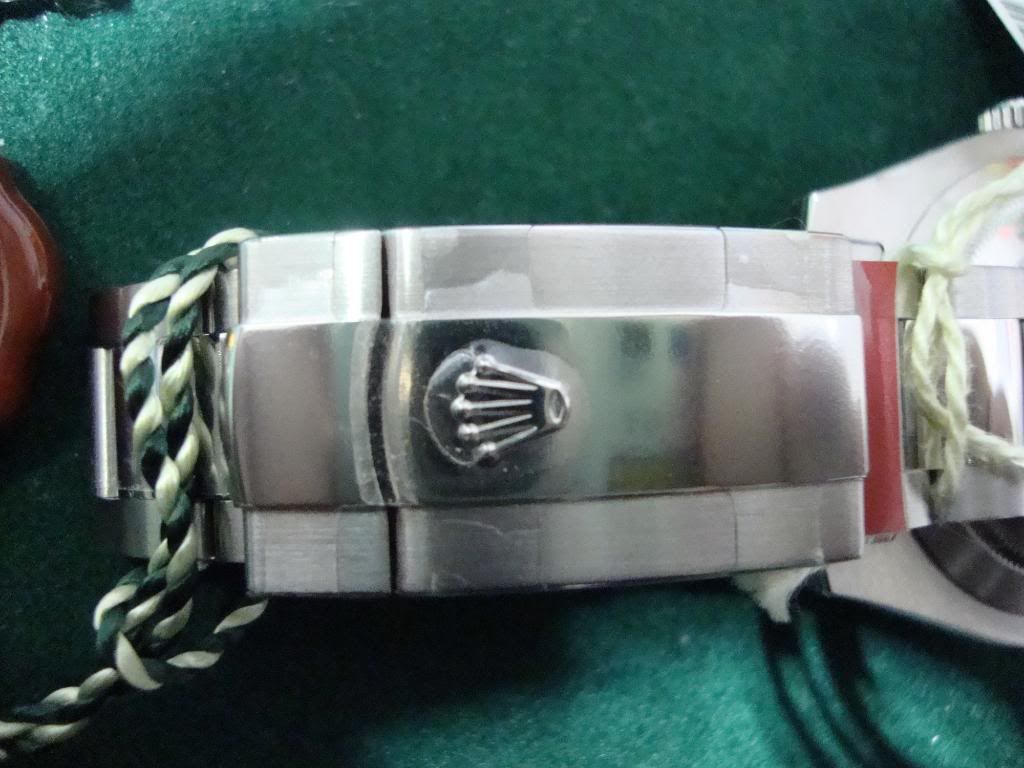
In terms of comfort, it's on the latest incarnation of the Oyster bracelet - solid end links and solid centre links. Solid, practical, and comfortable - you won't have any problems with hairs getting caught. There is some room for microadjustment on the clasp, and it also features the Easylink - an extra half link that can be concealed or extended. It's not as good as the Glidelock adjustment you can find on Rolex's diving watches, but it means you can still get the watch nice and comfortable. The clasp itself is solid and well engineered - Rolex have gone from producing some of the most basic clasps on the market to some of the best. It certainly gives you a sense of confidence whilst wearing it. The watch is relatively weighty, but not to the point where it's unconfortable - you know it's there, it's a feeling of security.


Value for Money

Okay, at a shade under £5000, it's not a cheap watch. It's about a 20% increase on the price of a 116234, and are you getting more watch for your money? Hard to say - obviously there's more gold in the bezel, and the 3136 is an entirely in-house movement (I'm not entirely sure what differences there are between the 3135 and the 3136, my feeling is that there won't be a significant change.) It also goes with the usual Rolex practice of the larger the watch in a family, the more expensive it is. For the time being, dial choices are relatively limited compared to the 36mm Datejust and only the fluted bezel and Oyster bracelet are available. I expect a Jubilee bracelet and Polished bezel to become available in the future, as well as more dials - keep an eye out at Basel, they might decide to launch some then. In terms of engineering, it can't be faulted. Feels and looks like a premium watch should, and the quality is bound to be extremely high too. Initially, it'll be a relatively exclusive watch, but it won't hold its value as well as the sports models.

Conclusion

I have to admit, this watch isn't for me - just a bit too big for my wrists. However, I can appreciate and understand what Rolex are aiming for with this watch. The oversized watch market is big business at the moment, and, for me, the Datejust II fills a nice niche, and is certainly a lot dressier and practical than a lot of other large watches. It's helped to revitalise a staple of the Rolex range, and I really hope this introduces a new generation to the brand, and shakes off the "old man" image that Rolex seem to have developed recently.

Thursday, 17 September 2009

Rolex Sea Dweller Deep Sea

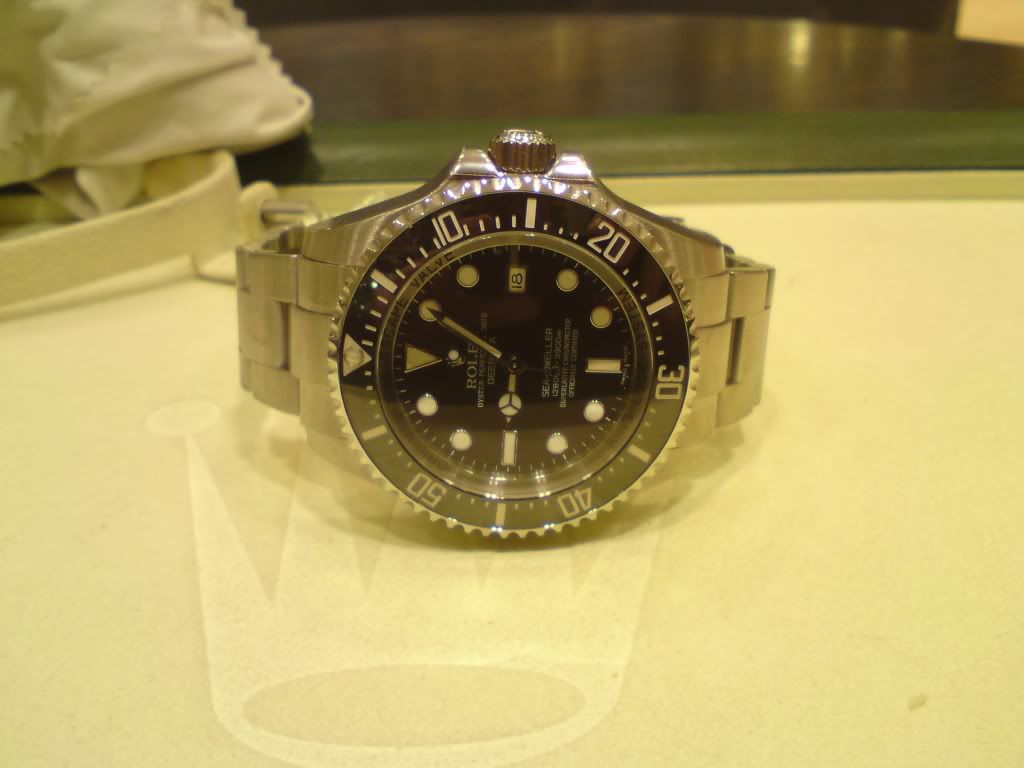
Big. Everything about this watch is big: the size, the depth rating, the price. It's the most extreme diving watch that Rolex have ever offered for sale, the only other watch they've ever made that can outdo it is the Deep Sea Special, which wasn't exactly a daily wearer. It's certainly an impressive watch - but is it as good as the hype would have you believe, and is it a viable watch for the ordinary watch wearer? I'll weigh up the pros and cons and come to my decision, and hopefully it might help yours as well.


Techincal Details

*Model Number: 116660
*904L Stainless Steel
*43mm Case Diameter
*Unidirectional rotating diving bezel, ceramic bezel insert with platinum numerals
*Maxi Dial and Hands, filled with Chromalight luminous material
*Ringlock system for extra strength at depth
*Automatic Helium Escape Valve
*Domed Sapphire crystal
*Titanium Caseback
*Oyster bracelet with Glidelock clasp
*Oversized Triplock crown
*Waterproof to 3900m/12800ft

The Movement

*Cal. 3135
*Self windng chronometer
*28.8k bph
*Quickset date complication
*Parachrom blue hairspring and Paraflex shock absorber system

UK RRP: £5790

The Aesthetics

Rolex have carried on their traditional diver's watch look: black dial, black bezel, easy to read and easy to see at night. Simple yet functional. However, this really does have a premium feel to it, and I, for one, feel that it is a huge improvement in terms of quality over the previous generation Sea Dweller. The bezel has a lovely feel to it, and glides smoothly into place, and has a lovely shine to it. Wisely, Rolex have kept the bracelet brushed, with only the case and bracelet sides being polished. This, for me, really means it stamps out its tool watch credentials straight away - it's not attracting attention to itself by being flashy, it's here to do a job and do it well. I love the honesty of it.

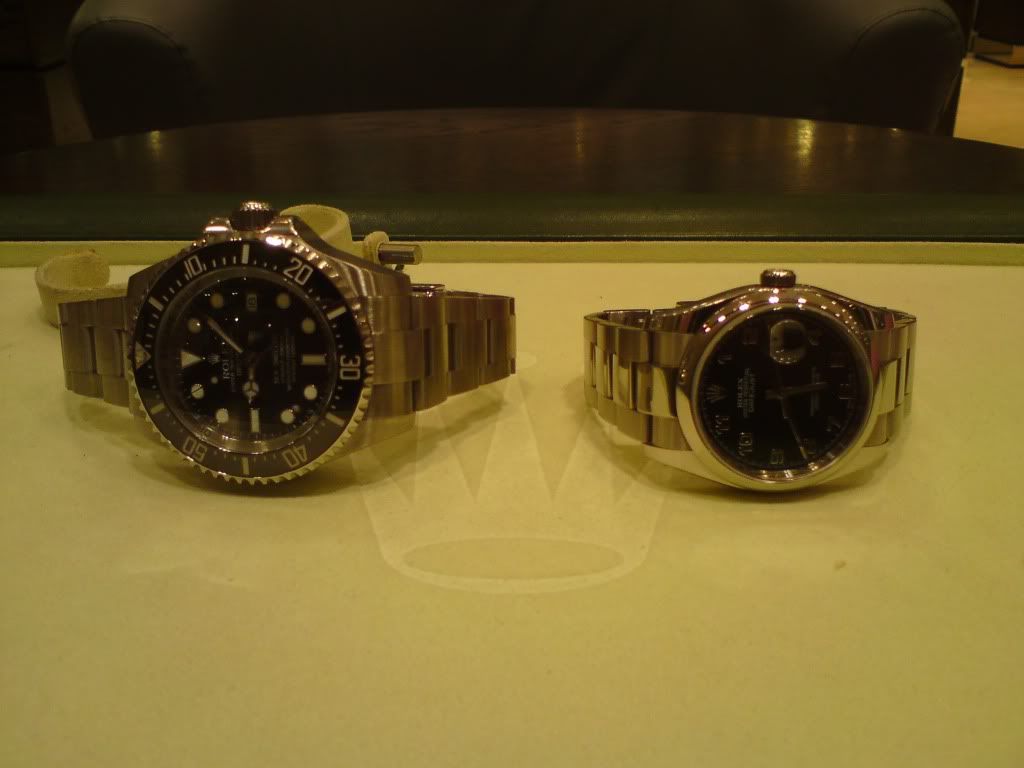
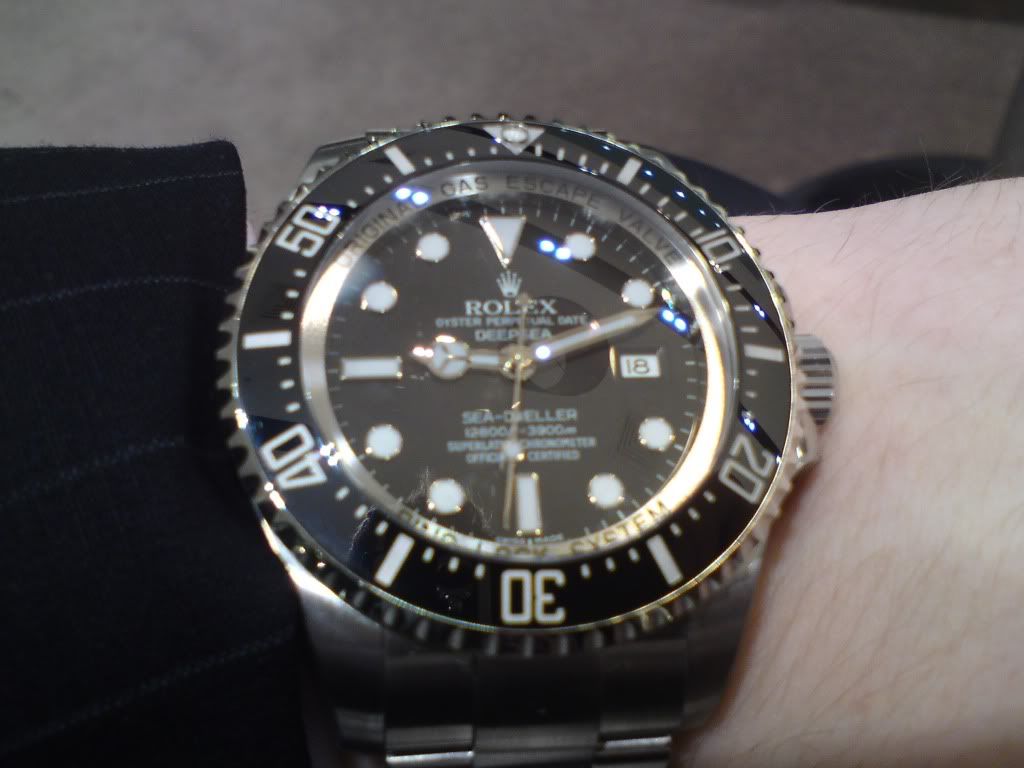
The size is a real "marmite" factor: some love the size of it, others hate it. In a world of Panerais, Breitlings and other oversized watches, 43mm for a case diameter is relatively modest. It's more the height of the watch which is an issue - I personally think it's just too tall for formal wear, there's no way of getting it comfortable under the cuff of a dress shirt. It absolutely dwarfs my Datejust:


However, it has the look of an industrial piece of engineering, it looks rough and ready to handle anything you could possibly throw at it. This is a watch crying out for outdoors activity, and I think that's the best place for it. In a business meeting, it'd look like a fish out of water, like a bodybuilder at a science fair. In it's element, however, it reigns supreme, and I'm sure the size and weight of it will give the wearer full confidence in it's abilities.


Practicality

As already mentioned above, this isn't the most practical of formal watches. Not something I'd personally recommend as an only watch, but if you had this in conjunction with a more suitable watch for work wear, then you have yourself what I think is a brilliant weekend watch. It's waterproof to a depth no human can physically dive to without a submersible, its brushed finish means scratches will be only a minor concern, the ceramic bezel is extremely durable, and the Glidelock clasp makes a particularly heavy and cumbersome watch surprisingly comfortable to wear. In fact, the Glidelock is such an important feature of the Deepsea, it needs a little section all to itself.


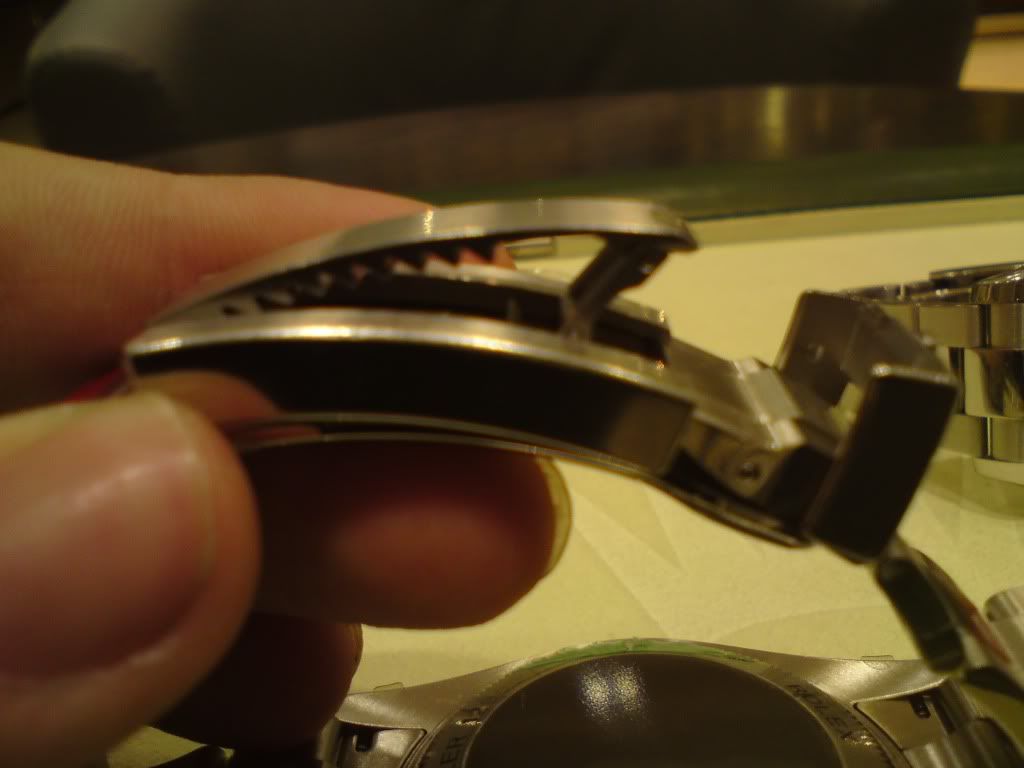
The Glidelock, for me, is the best practical innovation Rolex have developed in years. Whilst the Yachtmaster II's movement is a fantastic piece of horology, it's way out of reach for the average watch colector. The Glidelock, on the other hand, is a revolution in clasp adjustment, and won't just be available on the Deepsea, but the Submariner range as well: the new 18Ct and two tone models already have it, and the new steel version is expected to have it when launched too. Whilst ostensibly designed with wetsuits in mind (the diver's extension link remains with the Glidelock providing an extra 1.8cm of adjustment), it is the perfect feature for an ordinary user. Hot day? Let it out a notch or two. Want to play tennis? Tighten it up. The Glidelock removes the need to move pins in the clasp around - whilst you could get a high level of fine adjustment on the previous generation Sea Dweller, it was a fiddly, complicated and time consuming task compared to the Glidelock. To use it, simply undo the clasp, lift a finger under the edge (as pictured) and slide the link as much as you need. Takes all of 5 seconds. If I was the head of Rolex, I'd have that clasp placed on every single watch in the line up - my only criticism of the clasp is that it's only available on divers' models.

Value for Money

You certainly get a lot of watch for your money. Incredible engineering, high quality parts, bragging rights ("Oh, so your watch can go down to 300m? Nice, but look at mine..."), and that little bit of magic that will appeal to the 10 year old inside you. Of course, it's not a watch for everyone: its critics will cite its size and ostentatiousness as flaws, it'll be simply too much for most. But you need to look at this watch from Rolex's point of view, and I think they've been incredibly clever with this watch. Firstly, they needed a watch that could realistically compete in terms of chunkiness with Panerai and Breitling, and no one can argue that they haven't done that successfully. Secondly, they needed to reiterate their reputation as the makers of watches that can survive the harshest of places - the Deepsea is an excellent example of this, and testiment to their overengineering. Thirdly, they needed to underline their reputation as a maker of the highest quality sports watches, something that the (please forgive me) Submariner and Sea Dweller 4000 lacked. I see the Deepsea as a statement for Rolex's future, a reminder of what they do best. Yes, it's a big price increase compared to the old Sea Dweller, but this is in a completely different league. The Sea Dweller was an excellent watch for the 20th century, but the Deepsea is a 21st century watch through and through.

Conclusion

Excellent technical achievement, but not for everyone. Quite possibly the best engineered tool watch of all time, and truly the new benchmark in terms of sports watches.

Sunday, 6 September 2009

Chronoswiss Lunar Chronograph

This is another watch that has really caught my eye on my travels. Firstly, I should write a few words about Chronoswiss themselves, a largely unknown watch company that make some truly stunning timepieces. Founded in 1984 by Gerd-R. Lang, a former TAG master watchmaker, Chronoswiss is based in Germany, and makes timepieces focused on traditional watchmaking techniques, with some very modern technological advances. In the space of 25 years, Chronoswiss has grown to produce around 20000 timepieces per year worldwide, and win several prestigious awards. They have a very distinctive design ethos, with traditional case design, highly decorated movements, crystal display backs and the eponymous turnip-shaped winding crown. The movements themselves are largely heavily modified ETA movements, although recently they launched their own fully in-house movement. Their creative motto "Faszination der Mechanik" (the fascination of mechanics) is one that any true horology enthusiast can appreciate, and I for one love their bold designs, and impeccable attention to detail.


Technical Details

The particular model reviewed is the CH 7523 L bk, on a Louisiana crocodile leather strap.

*Case Diameter: 38mm
*Sapphire crystal both sides, one side Anti-Relective coated
*30m Water Resistance
*Stirling Silver dial

The Movement:

*Cal. c.755 (ETA 7750 base)
*28.8k beats per hour
*46 hour power reserve
*Self winding automatic
*Chronograph function with continuous seconds, minutes, hours and moonphase subdials
*Highly decorated finish

Retail price: £3920

The Aesthetics

The dial is quite a cluttered affair, with four subdials as well as an old-fashioned date display, so to the untrained eye, it can be somewhat daunting. However, this is one watch that can really sum up the "Faszination der Mechanik" mantra: there's always something intricate and intriguing to look at on both sides of the watch. If you'll excuse me for a moment, I'm going to, a la Top Gear, look at it from the perspective of a 10 year old boy. There's a lot happening with this watch, there's a hand to measure just about anything. Having a moonphase on your watch is quite the impressive statement, and the kind of gadget that could appeal to the child in any fully grown man. The chronograph function is just begging to be absent mindedly be fiddled with, the firm click of the top pusher bringing the long seconds hand into it's full sweeping majesty. Turning it over, there's even more to look at, with the crystal case back offering a tantalising glimpse into the innards of the watch. If you move the winding weight just so, you can see the beating heart of the watch in the form of the balance wheel whirring away, the escapement powering the tiny cogs within. This isn't just a watch, it's a piece of art.

The Practicality

Okay, so this watch could potentially be a bit over the top for every day wear, but it certainly is practical. Whilst the moonphase might not be of the utmost importance for the casual wearer, it has clear, if old-fashioned, date on it, and the chronograph function can come in handy in certain situations - a handy cooking tool, for example. The case has a brushed finish and sapphire crystals, and if combined with a leather strap, like the one reviewed, you won't have to worry about the perpetual problem of scratches. Once the leather has been worn in a little, the watch will be as comfortable as any, and Chronoswiss provide a myriad of colours for you to choose from. The one I've been handling had a very attractive blue strap on, which worked brilliantly. The level of water resistance means you don't have to worry about the watch getting wet should you accidentally immerse it, but I wouldn't recommend it for swimming.

Value for Money

At £3920, this is not a cheap watch by any stretch of the imagiation. For that kind of money, you're in Rolex Submariner/Breitling Navitimer/high-end Omega/Cartier territory. However, what Chronoswiss provides is the element of obscurity and exclusivity. With such low production numbers, the only place you're likely to bump into someone else wearing the same watch would be at a Watch Fair like Baselworld, or happen to be in an Authorised Dealer whilst someone else happens to purchase it. In terms of numbers, they have a similar production rate to Patek Philippe: my take on it is that Chronoswiss provides a Patek-like manufacturing ethos, Patek-like excusivity and a wholly unique design philosophy, all for the price of a mass-produced luxury watch brand. I don't know about you, but that makes this Chronoswiss seem like a very tempting proposition.


Finally...

Chronoswiss also offer this watch with a silver dial as well as a larger size, known as the "Grand Lunar". I strongly urge you to take a look at Chronoswiss' website: it's a great read, and make sure you check out the Lunar Chronograph under zoom and look at the workmanship on the dial. Truly phenomenal.


Thanks for reading

The GMT Master

Raymond Weil Tango Chronograph

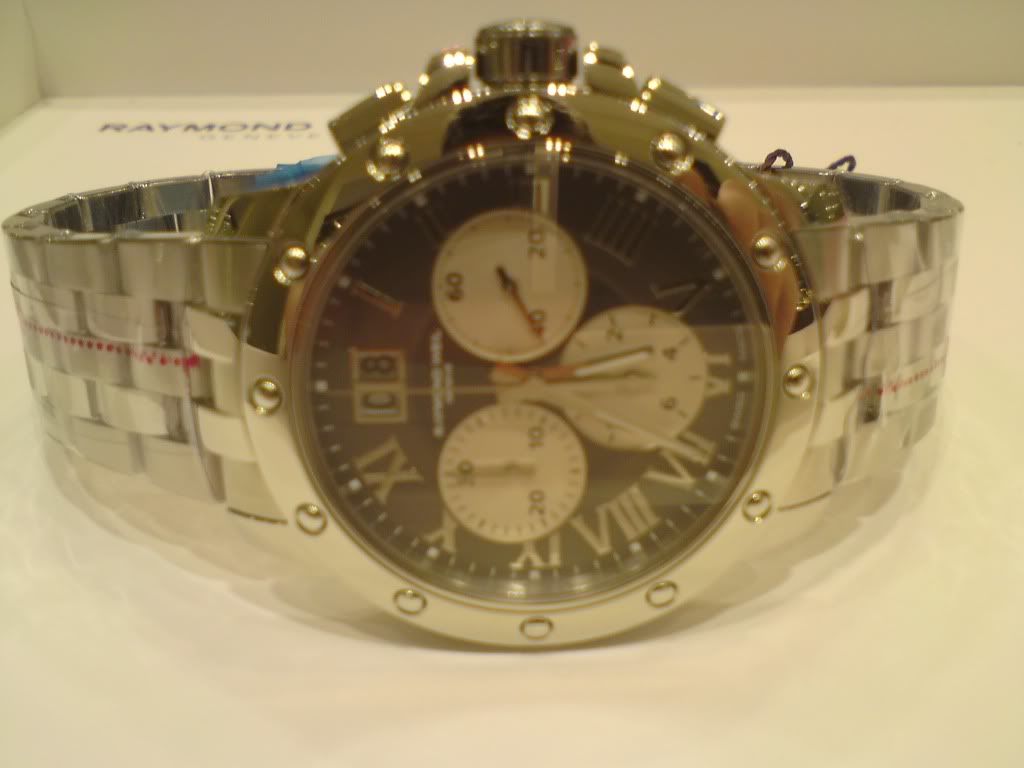
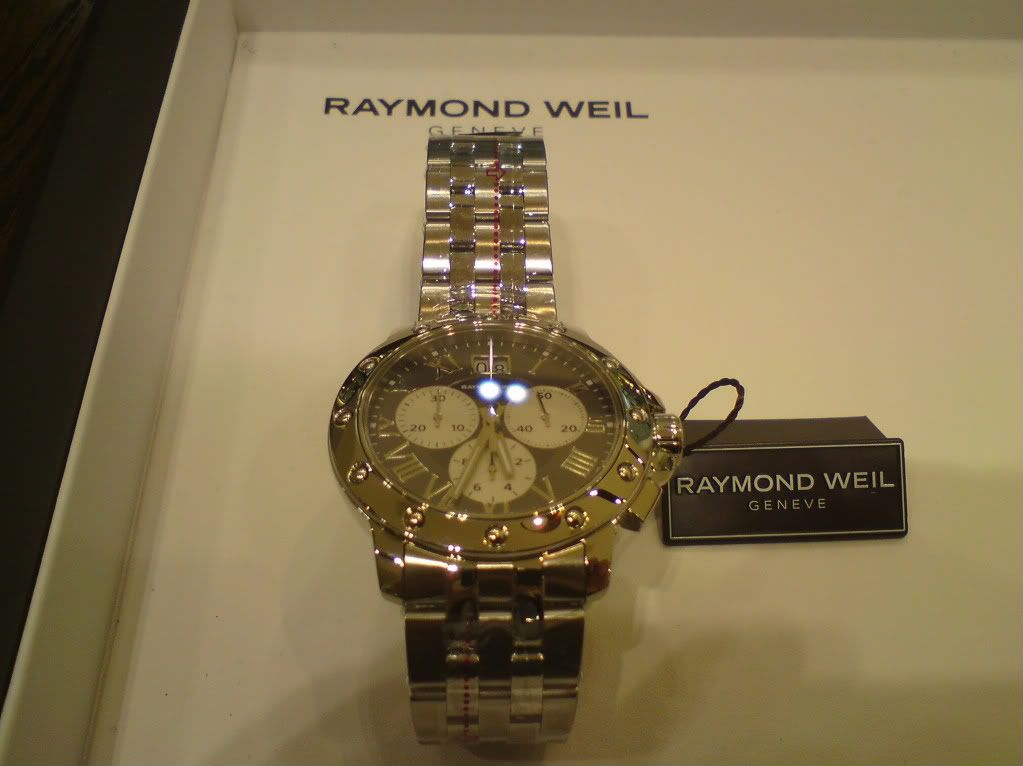
It's been a little while since I last updated this blog due to doing a lot of what I love doing best: selling high end watches. A couple of very successful weeks mean I've been going round with a smile on my face. Anyway, amidst the manic atmosphere at the shop, I was able to get my hands on one of the new arrivals, the Raymond Weil Tango Chronograph, a great looking watch, and a lovely addition to the Raymond Weil range. As a general rule, I've been struggling to find a watch that really appealed in their line up - undoubtedly nice quality watches, but just lacking that certain something that appeals to me. No longer: as soon as I saw this watch, I knew I had to take a much, much closer look.


The Technical Stuff

The model reviewed was the ref. 4899-ST-00668, which comes with the very attractive charcoal and silver dial. The watch is also available in an all black dial (ref. 4899-ST-00208), as well as options on leather straps.

*Case width: 40mm
*Sapphire Crystal
*Water Resistant to 50m
*Stainless steel
*Double push deployment clasp
*Big date (a particularly nice touch)
*Quartz Chronograph movement, w/ continuous seconds, 30 minute totaliser and 1/10th sub dials

RRP: £895

All in all a very nice little package, and quite a lot of watch for your money.


The Aesthetics

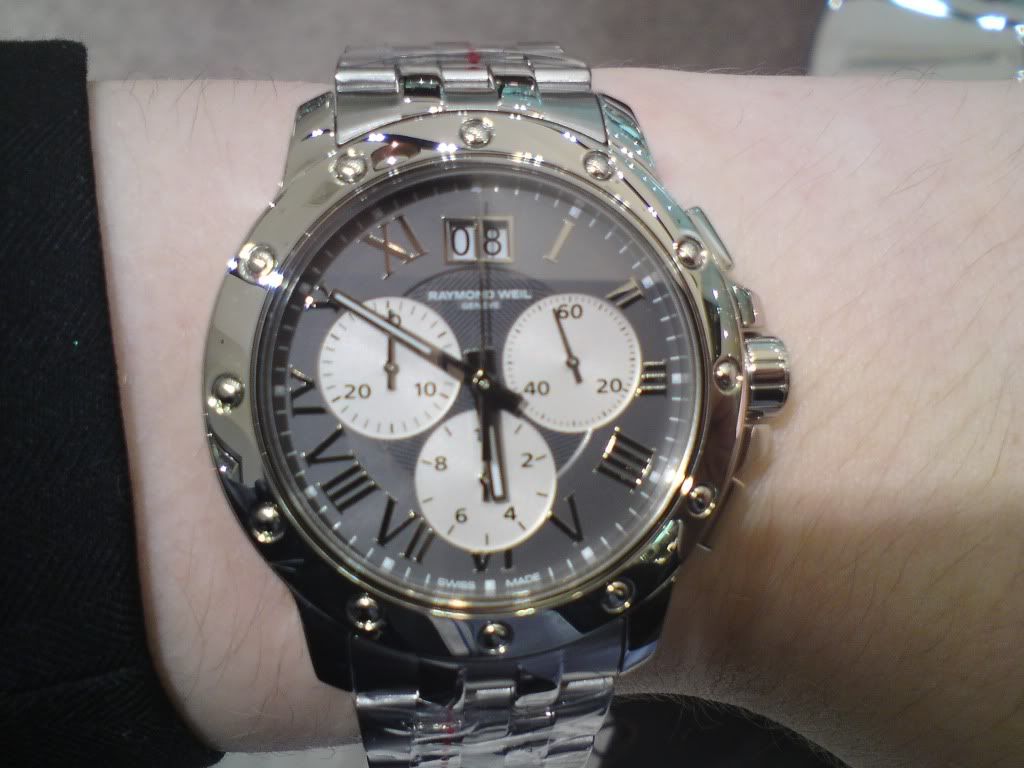
This watch is certainly good looking by any stretch of the imagination. For me, there are elements of Lange und Sohne, Rolex and Cartier in the design of this watch, and that's certainly no bad thing. The silver subdials are pleasing to the eye, and give a nice, subtle contrast, whilst the dial itself doesn't feel too cluttered, despite the array of features it offers. It has a nice weight to it, the clasp is solid and feels very secure, and the bracelet is more dressy than sporty. This feels like a watch more at home under a suit than one designed for the great outdoors. As shown in the photo below, it sits nicely on the wrist, and isn't overly large - the quartz movement stops the case from being too chunky.


Value for Money


Whilst it might be expensive for a quartz chronograph, the Tango Chronograph provides an elegent and robust entry to the world of luxury watches. At the price point it's at, I can see it being in competition with the likes of TAG and Omega, but out of all the models in the Raymond Weil range, I think this one can really hold it's own. In terms of practicality, it packs a lot of features into a very well presented package - to get a split seconds chronograph with oversized date, plus Roman numerals onto one dial without overcrowding it is no mean feat. When put next to a quartz Seamaster or F1, I think the Raymond's inherent dressiness can see it through, and provides an interesting alternative to more mainstream models.


Conclusion

Whilst the quartz movement may be a deterrent to some, this provides an excellent and unique pathway to the world of luxury watches. Raymond Weil is a brand often overlooked in favour of more heavily advertised marques, but this watch prooves that they can headturning yet classic timepiece for an exceptionally reasonable price.


Thanks for reading


The GMT Master

Tuesday, 4 August 2009

The Rolex GMT-Master IIc

I thought it was high time to scribble a few words about the watch that inspired my username: The GMT Master, specifically the current GMT IIc, first launched in 2005. I think this is a truly special watch, and, for me, sums up perfectly what a modern Rolex should be: robust, practical, and at the cutting edge of technology.


The History

For those of you not familiar with the roots of the GMT-Master, it has a really nice story about how it came into being. The original GMT was commissioned by head of Pan-Am Juan Trippe in 1955, due to a need for his air crew to have a time piece that could display two different time zones. Rolex obliged, and came up with a modified version of the original Turn-O-Graph, featuring the iconic blue and red "Pepsi" bezel, and a modified movement with an added 24 hour hand and date wheel. A very simple solution that resulted in a watch that is firmly embedded in the hearts of every Rolex enthusiast. Interestingly, Rolex also made a white-dialled version of the 6542 for Pan-Am management, as the watches intended for crew members had been finding their ways onto the wrists of the office workers. In any case, the GMT-Master has been refined and changed over the years, with the biggest change coming in around 1983 when the GMT-Master II was launched. This introduced an independent hours hand, meaning you can set the watch to display 3 different time zones (standard hour hand to local time, bezel to time zone 1, 24 hour hand to time zone 2). The most recent GMT II, ref. 116710/116713/116718 for the steel, two tone and 18ct models respectively was first introduced at Basel in 2005, with all models becoming available by the third quarter of 2007.

(Information taken from fiftyfathoms.net's excellent article on the 6542)

Model Features

The current model features a raft of updates from the previous generation, including:

"Maxi" case and dial (bigger case lugs, bigger dial indicies)
Fat hands
Cerachrom ceramic bezel with Platinum or 18Ct Gold numerals
New solid centre link bracelet, with polished centre links
Updated Fliplock clasp with Easylink half extension
Cal. 3186 movement, with Parachrom Blue hairspring and Paraflex shock resisters

The Comparison

Compared to the previous generation of GMT IIs (16710/16713/16718), it feels like a much more solid watch. There's a noticeable weight increase (no bad thing, in my opinion), and the watch appears bigger on the wrist, despite remaining at a conservative 40mm case diameter. The bezel looks fantastic, although it is a shame that Rolex haven't released a "pepsi" coloured bezel to date - apparently, it's proving very difficult to produce a ceramic bezel with those two colours in one complete piece, but I'm certain that Rolex are working hard on it. If it can be done, it will. As well as this, the previous 120 click bezel has been replaced by a 24 click one, which makes for a very smooth bezel movement, but lacks some of the fine accuracy that certain people enjoyed on the previous generation.

The Competition

Whilst rival brands such as Omega, Breitling, Panerai and Cartier all do GMT variations of their watches, none of them have the rich history of the GMT-Master. The stylings of the Rolex might not be to everyones' tastes, and I'm certain that some would prefer to have one from another brand: perhaps the bold looks of the PAM 297, or the ruggedness of the Breitling Colt GMT. But me, I'd go for the assured simplicity of the GMT IIc every time - I think this is the best watch Rolex has to offer at the moment in terms of looks, durability and practicality.

My recommendation: for every day practicality, the steel 116710. If you can live the the softness of gold, get the steel and 18Ct 116713 - by far the best two tone watch Rolex produces.

Thanks for reading

The GMT Master

Sunday, 2 August 2009

The Omega Aqua Terra - Omega's return to greatness?

If there's one watch that's really set my heart racing recently, it's the new Omega Seamaster Aqua Terra. Launched earlier this year, it's quality and looks are simply stunning, and in terms of value for money...well, I'll come back to that later.

Firstly a bit of eye candy for you all:


The Aesthetics

The Aqua Terra, in its basic format, comes in steel, steel and 18Ct Gold, and full 18Ct Gold. You have a choice of two dials in the steel model, either silver or dark grey with a tapestry-esque texturing, triangular luminous markers and arabics around the edge of the dial. There's a modern looking date aperture at 3 o'clock, and overall, the design concept is clearly modern with a definite 1950s' influence. Like any good watch, the dial is simple and uncluttered, the hands easy to read, and has a unique look that can't exactly be found on any other significant watch on the market at this time. The bracelet is solid and feels comfortable, and the clasp is a standard Omega double folding affair - not the best clasp I've seen on a watch, but it gets the job done. Inside the mid and full sized models is the truly brilliant cal. 8500.


The Movement

This is quite simply the best finished movement I've ever seen on a watch at this end of the market, and is truly a piece of art. It really is a centrepiece, and is shown off beautifully through the Sapphire display back.

The technical details:

25.2k bph
Co-Axial Escapement
60 hour power reserve
Chronometer rated
Omega's free sprung balance
Rhodium plated
Fully made in-house

In other words, a really nice piece of kit.

The Competition

Taking the mid-sized 38.5mm steel model for our baseline, the big competition comes from the Rolex Datejust 116200. In terms of looks, they are incredibly similar - the cases aren't all that different, the bracelet links are virtually the same, they're around the same size, and they both have chronometer rated self-winding movements. Whilst I'd argue that the Rolex's polished centre links make it look more dressy, I honestly think that the cal. 8500 has the potential to be better than the Datejust's cal. 3135. The cal. 8500 has been designed from the ground up (unlike past attempts to integrate the Co-Axial escapement into their range), so the reliability problems that plagued the previous Aqua Terra should have been solved. I think aesthetically it's a big selling point - it's proudly on show for the world to see, and Omega have every right to show it off. Rolex's movements have never been pretty, with them preferring to concentrate on function over form, so I doubt a factory option of a crystal caseback will be coming to the Oyster range any time soon.

Rolex once again has the edge when it comes to versatility: whilst Omega offers three different sizes (lady's, mid size, full size)in the different metal combinations, so does Rolex, with the added versatility of a huge range of dials, different bezels and different bracelets. This ability to customise your watch has always been the real appeal of the Datejust, and was one of the reasons why I chose mine. With Omega, you get the choice of a light dial, or a dark dial, take it or leave it.

However, the steel Aqua Terra is priced at a very reasonable £2600, whilst the Rolex weighs in at £3300 for its basic 116200 model. £700 is a big, big difference at this level of the market, and I'd reckon that the Omega will have a better scope for discount as well.

The Conclusion

The new Aqua Terra is certainly an excellent choice for someone who wants a simple and practical luxury watch that looks great, and is still good value for money. Whilst it may lack the range of individuality a Datejust can provide, it still is a massive step forward for Omega in their desire to return to greatness. This closes the gap closer still between the two rivals, that cal. 8500 is something that should have Rolex quaking in their boots.

My recommendation: the mid-size steel model /w black dial, reference 231.10.39.21.06.001

Thanks for reading

The GMT Master