Hello, sorry for the long period of time since my last blog update - I intend to make up for it by writing a couple more in-depth reviews over the next couple of days. But firstly, I thought I'd kick things off with a few words about the new watches of Basel 2010, now that they've had chance to reach reality.
I thought it was a slightly poor showing from Omega this year, nothing to really excite the senses, despite a raft of new models. We had yet another limited edition Speedmaster Professional, this time to commemorate the Apollo-Soyuz linkup. The main talking point is its Meteorite dial - a nice idea in theory, but in reality, it falls flat. The problem is, the Meteorite is too dark, and lacks the play of light that Rolex's Meteorite dials have, for example. If anything, it just makes it look as if the crystal has been scratched up. Then we have the price - at a smidge over £5000, you're looking at a £3000 premium over the standard model. Sure, you get a fancy box, but I can't see how it can be over double the price of the standard model, just because of the dial. In my opinion, Limited Edition Omegas being churned out every year is just damaging the collectibility of them, and surely that's what it's all about?
They also introduced a white version of the Plo Prof - not my cup of tea, but I think it may have a niche following. The only downside is that it is going to date horribly - I reckon this one will only stay in the range for 2 or 3 years at max. A new Double Eagle multi-counter chronograph has been launched (same movement as in the Olympic multi-counter chrono that came out a couple of years ago), which gives a very sporty look to the traditionally dressy Constellation line. However, I think with the black contrast bezel, crown and pushers, it looks too much like a TAG F1 for my liking. Plus, it's another chronograph in an already overcrowded range - I don't think it's going to have much of a following. The introduction of an Aqua Terra Annual Calendar is a nice idea, and gives a slightly more useful every day design option compared to the Hour Vision Annual Calendar, but I reckon the price might be prohibitive. Time will tell with that
Rolex's two big model revisions this year were the long-awaited introduction of the ceramic Submariner, both in black and green, and the much needed touch-up of the Explorer. Both subscribe to Rolex's new cutting-edge design ethos, and look brilliant in the flesh. The new Submariner is streets ahead of any other diver on the market (despite what some Planet Ocean LiquidMetal fanboys may say), and is a great example of what a modern sports watch should be. The Explorer has its own niche by being 39mm (sitting between the 36mm case diameter of the old Explorer, and the 41mm of the Milgauss), has a rather nice new matte dial, and, of course, a heavily revised bracelet. There has been some discontent over the size of the hands, but in reality, it really isn't an issue. I was very impressed by both of these models, in depth reviews will follow.
From other brands, the stand out for me was Breitling: they've launched a great looking and very affordable new SuperOcean. I love the choice of contrast colour chapter rings available, and the amount of performance for the price is very tempting. This could well eat into the market of the Omega SMP and the TAG Aquaracer.
There were, of course, plenty of other brands launching, but I feel these were the most worthy of commenting on. Hope you enjoyed the read, and stay tuned for more reviews!
Showing posts with label Musings. Show all posts
Showing posts with label Musings. Show all posts
Tuesday, 16 November 2010

Wednesday, 9 September 2009
Daytona Update
Well, it's official, I've decided to remove myself from the Daytona waiting list. For me, at least, the love affair with the most sought-after watch in the world is over. I've just come to the conclusion that too many people have one these days, and I've never been one to follow the crowd. The GMT IIc is definitely my new mistress.
Thanks
The GMT Master
Thanks
The GMT Master
Monday, 20 July 2009
Rolex Daytona: Worth It?
One watch that is always holds a deal of aura about it is the Rolex Daytona, and not a week goes by at the shop where I'm not asked about it. So, for the uninitiated, I'll take a few moments to explain what it is, and why it's so revered in the watch world.
The current Daytona comes in three basic forms: in stainless steel, in steel and 18Ct yellow gold and 18Ct gold (yellow, white and rose). It's a chronograph watch (a watch with a stopwatch function), comes on either the Oyster bracelet or a leather strap (only on the 18Ct models), and is quite a good looking watch by anyone's standards. The steel model starts at £6170, the two tone at just under the £9000 mark, the 18Ct models go for £19000, and if you want added diamonds and the like, the price keeps going up and up. However, the steel one is the one I'm going to focus on, as it is this one that is the Daytona.
The steel Daytona, ref. 116520, has a reputation as one of the hardest watches to buy new in the world. It's not due to the cost, but rather the huge waiting lists. I'm currently 40th on the waiting list at the shop, and at the current rate of Daytonas coming into stock, I have another 9 years to wait. Wherever you go in the UK, you'll get told there's a huge waiting list, and I don't know how many people I've seen walk out dejected when I tell them this. For the casual observer, there's nothing too fancy about it: it has an excellent movement inside it (the cal. 4130), but doesn't have features that you can't find on any other number of luxury watches. I can appreciate that the hype is a little bewildering, but I now have to put on my historian's hat to explain it all for you.
Let's cut back to the 1960s - insert whatever nostalgic recollections or conceptions you have here - and find a watch. The one we're after is the original Daytona, the ref. 6241 in particular.

If we were to ask the manager of the Rolex dealership how well this Daytona was selling, he's probably respond that it was a complete dead weight. Zero popularity, and highly unloved. Now we need to fast forward to Italy in the 1980s, which is where Daytona-mania really took off. All it needed was to be featured on the front page of an Italian fashion magazine to spark a rush to snap up this watch, especially that with the fabled "Paul Newman" exotic dial, as shown in the above picture. The desire for the Daytona spread around the world, with vintage pieces commanding huge prices at auction, and current models flying out of dealerships like proverbial hot cakes. The Daytona had become an icon.
Prices today, even with the recent financial crisis, still remain high - not so long ago, a 6241 sold at auction for a staggering Aus$80000. Let me remind you that this was for a 40 year old, steel manual wind chronograph, with a notoriously dodgy bracelet. Don't get me wrong, it's a lovely looking watch, but it's silly money for what it is. It doesn't even have an in-house Rolex movement, it uses a Valjoux 72 movement instead.
So let me get back to the current model: whilst it's difficult to get hold of brand new, it'll never be a collector's piece - it is, these days, a relatively common watch. You don't have to look too hard to find someone wearing one - Sir Alan Sugar, numerous football players, your run of the mill businessman, they'll have one strapped to their wrist. I think the thrill of getting a Daytona is trying to track one down - although I'm on the list for one, I'm not even sure if I want one any more. I think Rolex have better watches in their line up for less than the £6170 asking price of the Daytona, and I'd definitely want to look at those before a Daytona.
Then we have the prickly problem of the Daytona's biggest rival (at least in my eyes): The Omega Speedmaster Professional. There are plenty of similarities between the two: both launched at around the same time (the Speedy in 1957, the Daytona a couple of years after), both used manual wind movements, even aesthetically they were quite similar.

What's so special about this watch? The Speedmaster is the first and only watch worn on the moon, as well as the only watch that was NASA flight certified. When NASA were testing several chronographs for the Apollo programme, the Speedmaster was the only one that could withstand every single test thrown at it, beating several other chronographs, including the Rolex Daytona. Whilst vintage pieces do fetch handsome prices these days, the current model (pretty much the same watch as you could buy 40 years ago, albeit with a different manual wind movement and a much improved bracelet) is nowhere near as popular as the Daytona. It's a quarter of the price of a Daytona as well: you can walk away with a brand new Speedy Pro for £2090 retail, plus a little bit of discount too.
So, to get back to my original question, is the Rolex Daytona worth it? Well, for many it has a glittering alure, and I can see where they come from. I just personally think there are watches with more interesting backgrounds that can be had for a lot lot less, without the wait. If you buy a Daytona, you'll be getting a great watch in it's own right, but I often feel that the hype is a little unjustified.
The current Daytona comes in three basic forms: in stainless steel, in steel and 18Ct yellow gold and 18Ct gold (yellow, white and rose). It's a chronograph watch (a watch with a stopwatch function), comes on either the Oyster bracelet or a leather strap (only on the 18Ct models), and is quite a good looking watch by anyone's standards.
 The steel model starts at £6170, the two tone at just under the £9000 mark, the 18Ct models go for £19000, and if you want added diamonds and the like, the price keeps going up and up. However, the steel one is the one I'm going to focus on, as it is this one that is the Daytona.
The steel Daytona, ref. 116520, has a reputation as one of the hardest watches to buy new in the world. It's not due to the cost, but rather the huge waiting lists. I'm currently 40th on the waiting list at the shop, and at the current rate of Daytonas coming into stock, I have another 9 years to wait. Wherever you go in the UK, you'll get told there's a huge waiting list, and I don't know how many people I've seen walk out dejected when I tell them this. For the casual observer, there's nothing too fancy about it: it has an excellent movement inside it (the cal. 4130), but doesn't have features that you can't find on any other number of luxury watches. I can appreciate that the hype is a little bewildering, but I now have to put on my historian's hat to explain it all for you.
Let's cut back to the 1960s - insert whatever nostalgic recollections or conceptions you have here - and find a watch. The one we're after is the original Daytona, the ref. 6241 in particular.
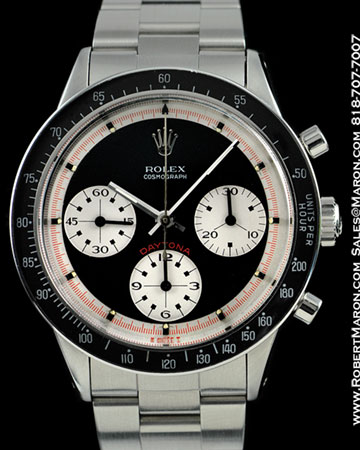
If we were to ask the manager of the Rolex dealership how well this Daytona was selling, he's probably respond that it was a complete dead weight. Zero popularity, and highly unloved. Now we need to fast forward to Italy in the 1980s, which is where Daytona-mania really took off. All it needed was to be featured on the front page of an Italian fashion magazine to spark a rush to snap up this watch, especially that with the fabled "Paul Newman" exotic dial, as shown in the above picture. The desire for the Daytona spread around the world, with vintage pieces commanding huge prices at auction, and current models flying out of dealerships like proverbial hot cakes. The Daytona had become an icon.
Prices today, even with the recent financial crisis, still remain high - not so long ago, a 6241 sold at auction for a staggering Aus$80000. Let me remind you that this was for a 40 year old, steel manual wind chronograph, with a notoriously dodgy bracelet. Don't get me wrong, it's a lovely looking watch, but it's silly money for what it is. It doesn't even have an in-house Rolex movement, it uses a Valjoux 72 movement instead.
So let me get back to the current model: whilst it's difficult to get hold of brand new, it'll never be a collector's piece - it is, these days, a relatively common watch. You don't have to look too hard to find someone wearing one - Sir Alan Sugar, numerous football players, your run of the mill businessman, they'll have one strapped to their wrist. I think the thrill of getting a Daytona is trying to track one down - although I'm on the list for one, I'm not even sure if I want one any more. I think Rolex have better watches in their line up for less than the £6170 asking price of the Daytona, and I'd definitely want to look at those before a Daytona.
Then we have the prickly problem of the Daytona's biggest rival (at least in my eyes): The Omega Speedmaster Professional. There are plenty of similarities between the two: both launched at around the same time (the Speedy in 1957, the Daytona a couple of years after), both used manual wind movements, even aesthetically they were quite similar.

What's so special about this watch? The Speedmaster is the first and only watch worn on the moon, as well as the only watch that was NASA flight certified. When NASA were testing several chronographs for the Apollo programme, the Speedmaster was the only one that could withstand every single test thrown at it, beating several other chronographs, including the Rolex Daytona. Whilst vintage pieces do fetch handsome prices these days, the current model (pretty much the same watch as you could buy 40 years ago, albeit with a different manual wind movement and a much improved bracelet) is nowhere near as popular as the Daytona. It's a quarter of the price of a Daytona as well: you can walk away with a brand new Speedy Pro for £2090 retail, plus a little bit of discount too.
So, to get back to my original question, is the Rolex Daytona worth it? Well, for many it has a glittering alure, and I can see where they come from. I just personally think there are watches with more interesting backgrounds that can be had for a lot lot less, without the wait. If you buy a Daytona, you'll be getting a great watch in it's own right, but I often feel that the hype is a little unjustified.
Time to make a start
Well, this is my first foray into the world of blogging. Whether this'll keep me occupied for long or not remains to be seen, but whilst this does hold my attention, I aim to write some vaguely interesting and possibly witty lines about watches, my thoughts on them, and what they mean to me.
Firstly, a little background information about me. I'm British, fortunate enough to work in an excellent watch shop, and have a passion for all things horological. I'm a huge fan of Rolex and Omega, and as much as I love the mid to high end of the market, I also like honest, well made entry level watches as well, especially brands like Rotary and Citizen. I don't think I've ever had much choice in liking watches - I was pretty much raised in a watch shop, and from an early age, I found timepieces fascinating, with my Dad commenting that I was a "clock-obsessed toddler." Apparently I kept a close eye on the stock, and would be able to know exactly which ones had been sold. However, my passion had remained fairly dormant up until about two years ago when I got my first job at the local Rolex dealership, which sparked off a drive to learn more about watches and how they work. I've learnt from both the managers of the shop, as well as the fine community at www.rolexforums.com - hell, I've learnt nuggets of information that people who have been in the jewellery industry for close to 30 years didn't know. I've been able to pick up a great deal of information in a very short period of time, and I have some fairly solid opinions on what I like and don't like.
Anyway, I'm a fairly strong believer in the notion that you can tell a lot about a person by the watch they wear: perhaps you'll come to your own conclusions about myself and my collection as well. I have a rather modest selection of watches for the time being, but they are my pride and joy.
The first one, and the centrepiece of my collection is my Rolex Datejust 116200 - stainless steel, self winding chronometer rated movement, Oyster bracelet, polished steel bezel and a black arabic dial. Has a nice weight to it, measures in with a case diameter of 36mm, and has a classic look with a contemporary twist. People often have strong opinions when it comes to Rolex, as well as a lot of preconceptions, but I think this watch is as far away from the flashy, gaudy, impractical watch that people often think of when the word "Rolex" is mentioned. Here it is:

Pretty, no?
The other two watches in my possession are both Rotary chronographs, one in similar style to the Rolex Daytona, and the other in the style of a Breitling Navitimer. I got both of these for less than £100 each, and for the money, I challenge you to find a better watch in terms of looks, prestiege and quality. I'm currently wearing the leather strapped one as my daily beater - there's nothing more comfortable than a leather strapped watch on a hot summer's day.


Thanks for reading, and I hope you enjoy the future articles I write.
Much love
The GMT Master
Firstly, a little background information about me. I'm British, fortunate enough to work in an excellent watch shop, and have a passion for all things horological. I'm a huge fan of Rolex and Omega, and as much as I love the mid to high end of the market, I also like honest, well made entry level watches as well, especially brands like Rotary and Citizen. I don't think I've ever had much choice in liking watches - I was pretty much raised in a watch shop, and from an early age, I found timepieces fascinating, with my Dad commenting that I was a "clock-obsessed toddler." Apparently I kept a close eye on the stock, and would be able to know exactly which ones had been sold. However, my passion had remained fairly dormant up until about two years ago when I got my first job at the local Rolex dealership, which sparked off a drive to learn more about watches and how they work. I've learnt from both the managers of the shop, as well as the fine community at www.rolexforums.com - hell, I've learnt nuggets of information that people who have been in the jewellery industry for close to 30 years didn't know. I've been able to pick up a great deal of information in a very short period of time, and I have some fairly solid opinions on what I like and don't like.
Anyway, I'm a fairly strong believer in the notion that you can tell a lot about a person by the watch they wear: perhaps you'll come to your own conclusions about myself and my collection as well. I have a rather modest selection of watches for the time being, but they are my pride and joy.
The first one, and the centrepiece of my collection is my Rolex Datejust 116200 - stainless steel, self winding chronometer rated movement, Oyster bracelet, polished steel bezel and a black arabic dial. Has a nice weight to it, measures in with a case diameter of 36mm, and has a classic look with a contemporary twist. People often have strong opinions when it comes to Rolex, as well as a lot of preconceptions, but I think this watch is as far away from the flashy, gaudy, impractical watch that people often think of when the word "Rolex" is mentioned. Here it is:

Pretty, no?
The other two watches in my possession are both Rotary chronographs, one in similar style to the Rolex Daytona, and the other in the style of a Breitling Navitimer. I got both of these for less than £100 each, and for the money, I challenge you to find a better watch in terms of looks, prestiege and quality. I'm currently wearing the leather strapped one as my daily beater - there's nothing more comfortable than a leather strapped watch on a hot summer's day.


Thanks for reading, and I hope you enjoy the future articles I write.
Much love
The GMT Master
Subscribe to:
Posts (Atom)
