Hello, sorry for the long period of time since my last blog update - I intend to make up for it by writing a couple more in-depth reviews over the next couple of days. But firstly, I thought I'd kick things off with a few words about the new watches of Basel 2010, now that they've had chance to reach reality.
I thought it was a slightly poor showing from Omega this year, nothing to really excite the senses, despite a raft of new models. We had yet another limited edition Speedmaster Professional, this time to commemorate the Apollo-Soyuz linkup. The main talking point is its Meteorite dial - a nice idea in theory, but in reality, it falls flat. The problem is, the Meteorite is too dark, and lacks the play of light that Rolex's Meteorite dials have, for example. If anything, it just makes it look as if the crystal has been scratched up. Then we have the price - at a smidge over £5000, you're looking at a £3000 premium over the standard model. Sure, you get a fancy box, but I can't see how it can be over double the price of the standard model, just because of the dial. In my opinion, Limited Edition Omegas being churned out every year is just damaging the collectibility of them, and surely that's what it's all about?
They also introduced a white version of the Plo Prof - not my cup of tea, but I think it may have a niche following. The only downside is that it is going to date horribly - I reckon this one will only stay in the range for 2 or 3 years at max. A new Double Eagle multi-counter chronograph has been launched (same movement as in the Olympic multi-counter chrono that came out a couple of years ago), which gives a very sporty look to the traditionally dressy Constellation line. However, I think with the black contrast bezel, crown and pushers, it looks too much like a TAG F1 for my liking. Plus, it's another chronograph in an already overcrowded range - I don't think it's going to have much of a following. The introduction of an Aqua Terra Annual Calendar is a nice idea, and gives a slightly more useful every day design option compared to the Hour Vision Annual Calendar, but I reckon the price might be prohibitive. Time will tell with that
Rolex's two big model revisions this year were the long-awaited introduction of the ceramic Submariner, both in black and green, and the much needed touch-up of the Explorer. Both subscribe to Rolex's new cutting-edge design ethos, and look brilliant in the flesh. The new Submariner is streets ahead of any other diver on the market (despite what some Planet Ocean LiquidMetal fanboys may say), and is a great example of what a modern sports watch should be. The Explorer has its own niche by being 39mm (sitting between the 36mm case diameter of the old Explorer, and the 41mm of the Milgauss), has a rather nice new matte dial, and, of course, a heavily revised bracelet. There has been some discontent over the size of the hands, but in reality, it really isn't an issue. I was very impressed by both of these models, in depth reviews will follow.
From other brands, the stand out for me was Breitling: they've launched a great looking and very affordable new SuperOcean. I love the choice of contrast colour chapter rings available, and the amount of performance for the price is very tempting. This could well eat into the market of the Omega SMP and the TAG Aquaracer.
There were, of course, plenty of other brands launching, but I feel these were the most worthy of commenting on. Hope you enjoyed the read, and stay tuned for more reviews!
Showing posts with label Omega. Show all posts
Showing posts with label Omega. Show all posts
Tuesday, 16 November 2010

Tuesday, 15 December 2009
A Friendly Dive Watch Comparison: Submariner vs. Seamaster Professional
Firstly, my apologies for not updating the blog more recently - work has been catching up with me, hence why it's been a little quiet over here. However, I have a few new articles I've been working on, which should hopefully be written up within the next few days.
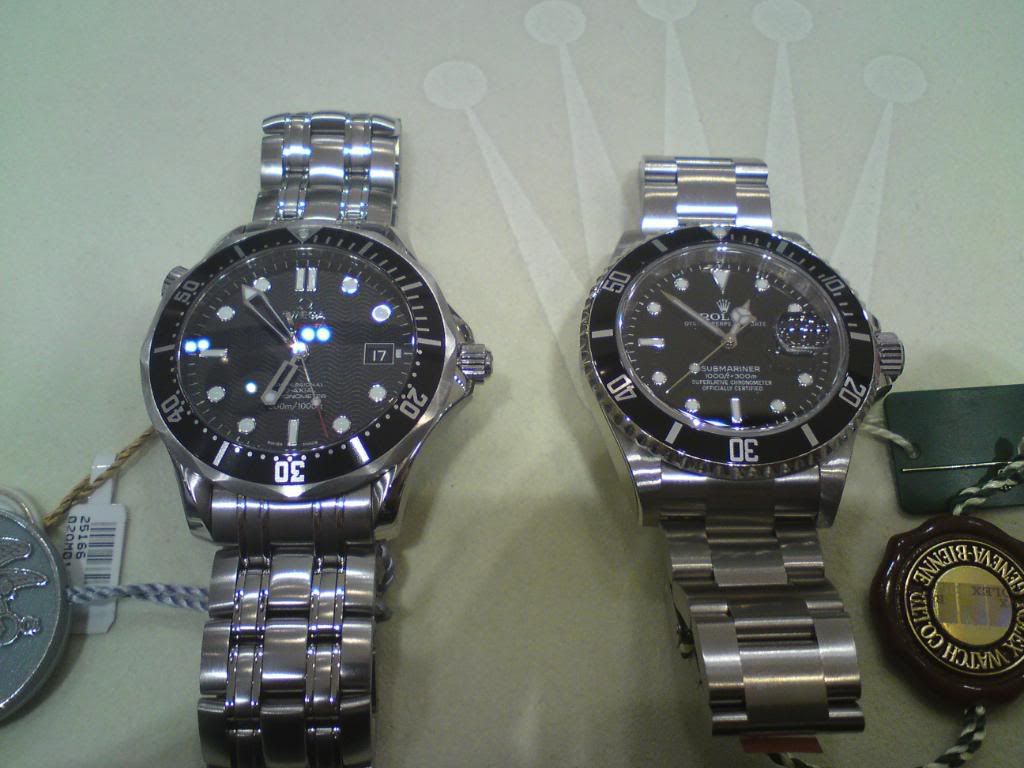
The first of which is a comparison between two icons of the diving watch world: the Rolex Submariner Date and the Omega Seamaster Professional. With the introduction of the black dialled version, as well as Omega's reluctance to push prices up as steeply as Rolex, the Seamaster is looking like a better and better buy every day. Conversely, despite coming to the end of its operational life, the Submariner continues to be one of the most popular models in the Rolex range, and has amassed a serious fanbase since its original inception in 1953. The models I will be reviewing are the Submariner 16610, and the Seamaster 212.30.41.20.01.002.

Technical Specifications (Sub vs. SMP)
Case Diameter: 40mm - 41mm
Cal. Number: Rolex 3135 - Omega 2500
Automatic?: Yes - Yes
BPH: 28.8k - 25.2k
Power Reserve: ~40 hours - 48 hours
COSC Certified?: Yes - Yes
Material: 904L Steel - 316L Steel
Waterproofing: 300m - 300m
Screw-down crown?: Yes - Yes
Helium Escape Valve?: No - Yes
Crystal: Sapphire - Sapphire
Anti-reflective coating?: No - Inside only
Luminous Material: Green Super-Luminova - Blue Super-Luminova
Unidirectional Rotating Bezel?: Yes - Yes
Price (UK RRP): £3890 - £1860
The Aesthetics
With the introduction of the black dial on the SMP, there is very little to distinguish between the two at a glance, at least with an untrained eye. Indeed, the basic dial layout of dots-and-dashes hour markers is the classic dive watch look - simple, practical, legible. The biggest difference on the dial itself is the finish - the Submariner goes for a gloss finish, whilst the Seamaster adopts a wave finish, designed to reduce glare whilst diving.
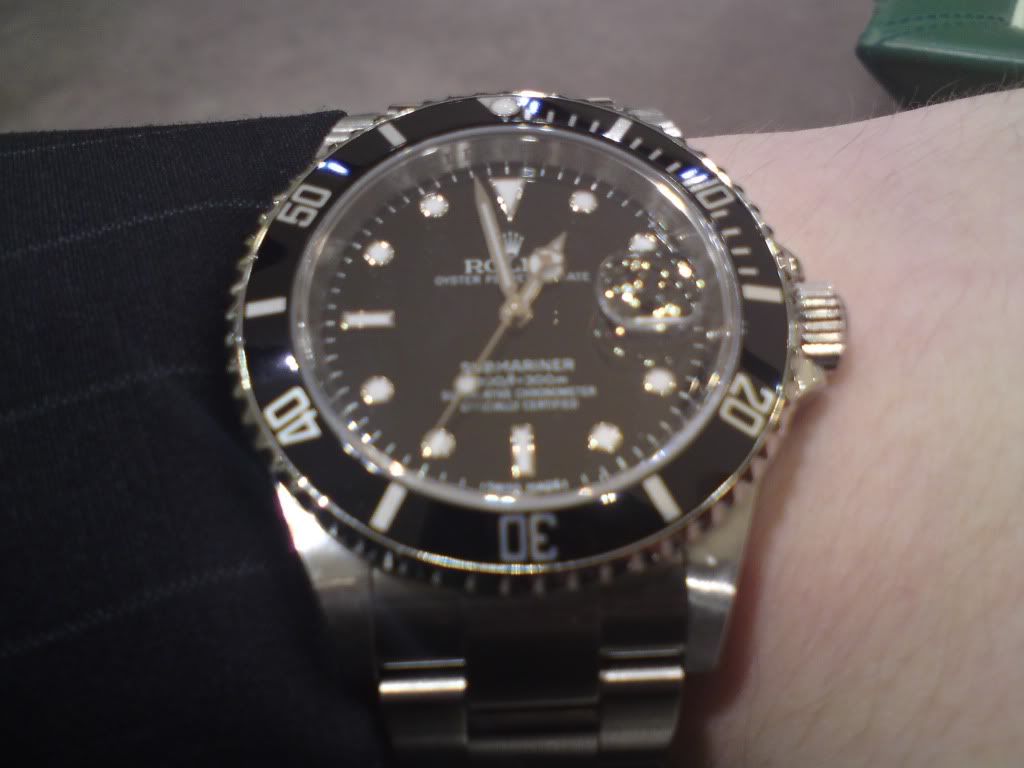
The other large cosmetic difference on the face of the watch would be the cyclops magnifying bubble on the Sub - although some really don't like this feature, I, for one, think it's an essential part of the Rolex look, and handy for looking at the date quickly. The date window on the SMP is pretty small, and can be difficult to read at a glance. As a general rule, the Submariner is a lot shinier than the Seamaster, owing to the gloss finish and lack of AR coating, and whilst this makes for a "dressier" look, it could be a potential problem for legibility in bright light.
As such, there is little to separate the watches in terms of aesthetics, and it really boils down to personal preference. For me, the Rolex just edges it in this respect.
The Bracelet
It's my personal view that the bracelet is just as important as the watch head when considering a watch - after all, the bracelet and clasp determines the "feel" of the watch, and dictates how comfortable it is to wear every day. Certainly, there is a large difference between the two watches in regards to this.
The Submariner uses a brushed-finish Oyster bracelet, with solid end links, but hollow centre links, whilst the SMP uses an exclusive bracelet with polished higlights and solid links throughout. The first thing that I noticed with the Submariner bracelet is just how light the bracelet felt - a positive for someone who wants a dive-watch without the typical dive-watch heft - but also how rattly it felt. One has to bear in mind that the 16610 was launched 20 years ago, and it really is beginning to feel like its age. Submariner enthusiasts will point out that it's a strong and reliable bracelet, ready to take the abuses of every day life, and I completely agree. However, when you put it against one of the new-style Rolex bracelets, such as the one on the GMT IIc, the Submariner's band just feels cheap.
The Seamaster's bracelet, on the other hand, gives the wearer a feeling of confidence. It's substantial without being overbearing, and sits nicely on the wrist. It also looks a little dressier than the Rolex's, with the polished sections of the links just giving it a little bit of contrast.
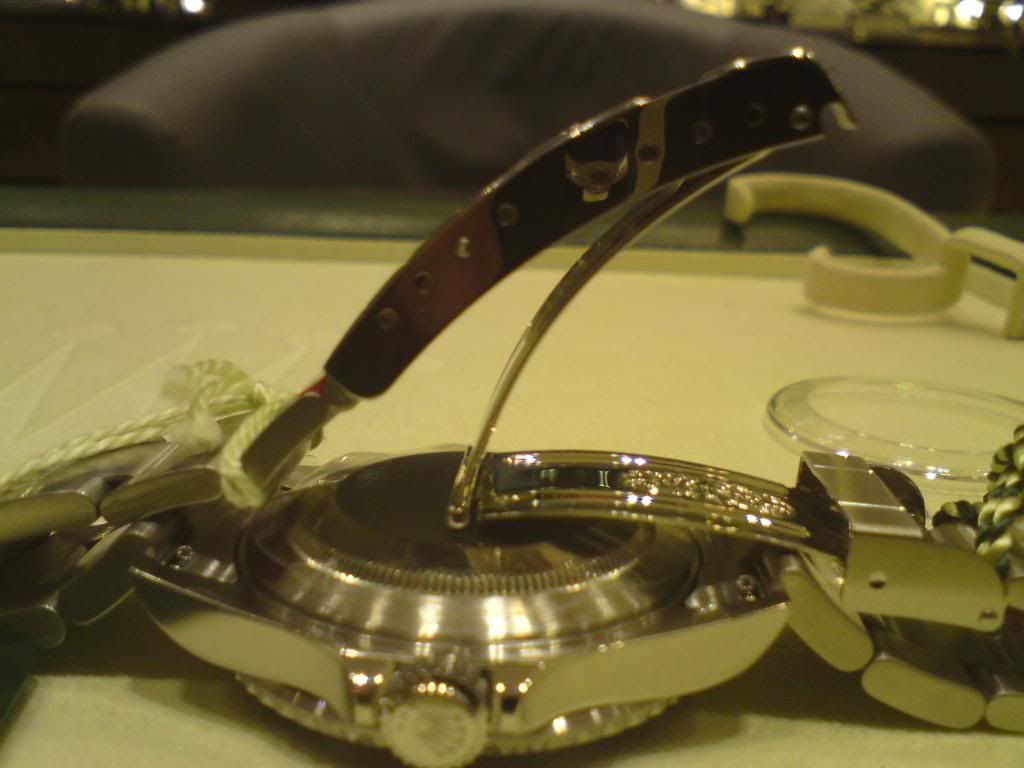
There's a similar story with the clasps - the best word to describe the Submariner's clasp is outdated. It still uses the folded-metal clasp, which is wafer thin, and, to be quite frank, would feel wrong on a £500 watch, let alone a near-£4000 watch. Again, it can be argued that it's served it's purpose for a long time, and I won't deny that, but placed against the brilliant Glidelock clasp (see the Deepsea Review if you haven't come across it yet), it feels like an ancient relic:

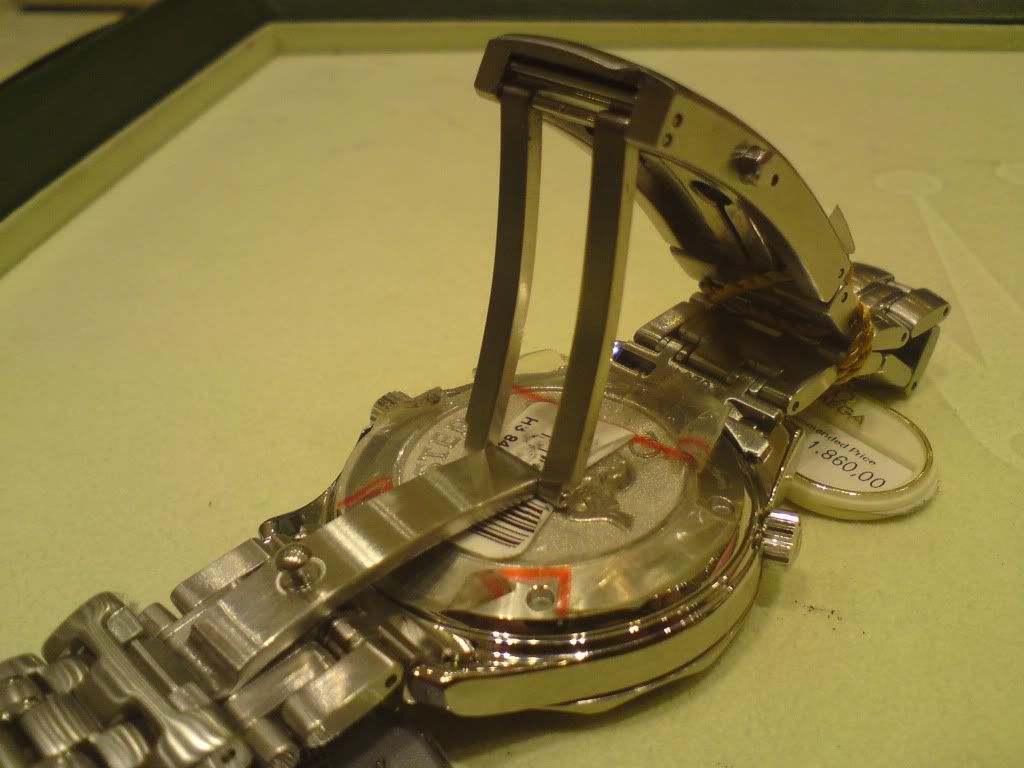
I certainly think that the clasp is the biggest drawback on the Submariner, especially in comparison to the Omega clasp:

The Omega uses a push putton deployment clasp which won't have the same problems with the blades bending over time like the Submariner. It feels like a more heavy-duty clasp as well, and the quality of the engineering can't be faulted. Indeed, some argue that Omega's clasps sparked Rolex's drive for updating their own clasps. Omega wins convincingly here.
The Practicality
The Submariner has long been known as one of the best all-rounders out there - bash it around by day, and it'll still look perfect with a tuxedo. It truly is one of the watch world's greatest chameleons. The "James Bond" aspect has a lot to do with this, and applies to both watches - for someone who wants just one watch that can do everything, then the Sub or the SMP is a worthy choice. Neither are particularly chunky, so wearing one under a cuff isn't an issue. There's virtually nothing to distinguish between the two in this respect. A tie.
Value for Money
As I've asserted throughout the article, in many respects, the SMP is the equal of the Submariner, and in other respects, its superior. Indeed, the biggest difference between the two watches is the price, and I don't think this reflects the quality of the watches - the Submariner certainly isn't double the watch that the Seamaster is. It should also be noted that, due to the use of the Co-Axial escapement in the Seamaster, you get a 3 year guarantee on the Omega, as opposed to the 2 year on the Rolex. When buying new, there's also a bigger scope for discount on a Seamaster as well - most ADs will be unwilling to give more than a token discount on a Submariner owing to its continued popularity. Whilst buying new makes the Omega the rational choice, one also has to take into account resale value, and this is where the Rolex really comes into play. You can always rely on a steel sports Rolex to hold a substantial amount of its value, even a few years down the line. However, the depreciation on an Omega is brutal, and you'll struggle to sell it for muh more than half the RRP a year down the line. In some respects, you are paying extra for the Rolex marque, but it will help to give you a better return should you want to move on further down the line
However, it must be noted that an updated Submariner is expected to be launched in March 2010, hitting ADs in this country in around October/November. Whilst this might spark a small spike in demand for the 16610 as its phased out (in th same way there was a small hype for V-series Sea-Dwellers before the arrival of the Deep Sea), in the long term it will, in all likelihood, give second hand values of the 16610 a beatung. As such, the Submariner isn't quite the safe investment that it used to be.
Omega wins on value for money.
Conclusion
The Submariner 16610 has done the Rolex range proud for the past 20 years, and I'd argue that it's the pinnacle of 20th Century dive watches. The allure that it's created is simply phenomenal, and the fact that it's lasted such a long time pays a compliment to Rolex's overengineering at the time. However, its time has come to an end, and for the past few years, the Seamaster has been the sensible choice. I expect things will shift back into Rolex's favour come Basel 2010, and I can't wait for the rebirth of such an iconic watch.

If you asked me tomorrow which one to buy, I'd personally go for the Seamaster - it's quite possibly the best value luxury watch on the market. However, regardless of a rational approach, the Submariner does have the Rolex "magic," and that, for some, will be enough.

On a final note, if you want to get your hands on a new 16610, don't hang around - according to sources on TRF, Rolex USA has already run out of stock of them, and won't be getting any more steel Subs until the new model arrives. I don't know for certain whether this will be the case in the UK - as far as I'm aware, Rolex UK still has supplies in stock.
Thanks for reading
The GMT Master
The first of which is a comparison between two icons of the diving watch world: the Rolex Submariner Date and the Omega Seamaster Professional. With the introduction of the black dialled version, as well as Omega's reluctance to push prices up as steeply as Rolex, the Seamaster is looking like a better and better buy every day. Conversely, despite coming to the end of its operational life, the Submariner continues to be one of the most popular models in the Rolex range, and has amassed a serious fanbase since its original inception in 1953. The models I will be reviewing are the Submariner 16610, and the Seamaster 212.30.41.20.01.002.
Technical Specifications (Sub vs. SMP)
Case Diameter: 40mm - 41mm
Cal. Number: Rolex 3135 - Omega 2500
Automatic?: Yes - Yes
BPH: 28.8k - 25.2k
Power Reserve: ~40 hours - 48 hours
COSC Certified?: Yes - Yes
Material: 904L Steel - 316L Steel
Waterproofing: 300m - 300m
Screw-down crown?: Yes - Yes
Helium Escape Valve?: No - Yes
Crystal: Sapphire - Sapphire
Anti-reflective coating?: No - Inside only
Luminous Material: Green Super-Luminova - Blue Super-Luminova
Unidirectional Rotating Bezel?: Yes - Yes
Price (UK RRP): £3890 - £1860
The Aesthetics
With the introduction of the black dial on the SMP, there is very little to distinguish between the two at a glance, at least with an untrained eye. Indeed, the basic dial layout of dots-and-dashes hour markers is the classic dive watch look - simple, practical, legible. The biggest difference on the dial itself is the finish - the Submariner goes for a gloss finish, whilst the Seamaster adopts a wave finish, designed to reduce glare whilst diving.
The other large cosmetic difference on the face of the watch would be the cyclops magnifying bubble on the Sub - although some really don't like this feature, I, for one, think it's an essential part of the Rolex look, and handy for looking at the date quickly. The date window on the SMP is pretty small, and can be difficult to read at a glance. As a general rule, the Submariner is a lot shinier than the Seamaster, owing to the gloss finish and lack of AR coating, and whilst this makes for a "dressier" look, it could be a potential problem for legibility in bright light.
As such, there is little to separate the watches in terms of aesthetics, and it really boils down to personal preference. For me, the Rolex just edges it in this respect.
The Bracelet
It's my personal view that the bracelet is just as important as the watch head when considering a watch - after all, the bracelet and clasp determines the "feel" of the watch, and dictates how comfortable it is to wear every day. Certainly, there is a large difference between the two watches in regards to this.
The Submariner uses a brushed-finish Oyster bracelet, with solid end links, but hollow centre links, whilst the SMP uses an exclusive bracelet with polished higlights and solid links throughout. The first thing that I noticed with the Submariner bracelet is just how light the bracelet felt - a positive for someone who wants a dive-watch without the typical dive-watch heft - but also how rattly it felt. One has to bear in mind that the 16610 was launched 20 years ago, and it really is beginning to feel like its age. Submariner enthusiasts will point out that it's a strong and reliable bracelet, ready to take the abuses of every day life, and I completely agree. However, when you put it against one of the new-style Rolex bracelets, such as the one on the GMT IIc, the Submariner's band just feels cheap.
The Seamaster's bracelet, on the other hand, gives the wearer a feeling of confidence. It's substantial without being overbearing, and sits nicely on the wrist. It also looks a little dressier than the Rolex's, with the polished sections of the links just giving it a little bit of contrast.
There's a similar story with the clasps - the best word to describe the Submariner's clasp is outdated. It still uses the folded-metal clasp, which is wafer thin, and, to be quite frank, would feel wrong on a £500 watch, let alone a near-£4000 watch. Again, it can be argued that it's served it's purpose for a long time, and I won't deny that, but placed against the brilliant Glidelock clasp (see the Deepsea Review if you haven't come across it yet), it feels like an ancient relic:
I certainly think that the clasp is the biggest drawback on the Submariner, especially in comparison to the Omega clasp:
The Omega uses a push putton deployment clasp which won't have the same problems with the blades bending over time like the Submariner. It feels like a more heavy-duty clasp as well, and the quality of the engineering can't be faulted. Indeed, some argue that Omega's clasps sparked Rolex's drive for updating their own clasps. Omega wins convincingly here.
The Practicality
The Submariner has long been known as one of the best all-rounders out there - bash it around by day, and it'll still look perfect with a tuxedo. It truly is one of the watch world's greatest chameleons. The "James Bond" aspect has a lot to do with this, and applies to both watches - for someone who wants just one watch that can do everything, then the Sub or the SMP is a worthy choice. Neither are particularly chunky, so wearing one under a cuff isn't an issue. There's virtually nothing to distinguish between the two in this respect. A tie.
Value for Money
As I've asserted throughout the article, in many respects, the SMP is the equal of the Submariner, and in other respects, its superior. Indeed, the biggest difference between the two watches is the price, and I don't think this reflects the quality of the watches - the Submariner certainly isn't double the watch that the Seamaster is. It should also be noted that, due to the use of the Co-Axial escapement in the Seamaster, you get a 3 year guarantee on the Omega, as opposed to the 2 year on the Rolex. When buying new, there's also a bigger scope for discount on a Seamaster as well - most ADs will be unwilling to give more than a token discount on a Submariner owing to its continued popularity. Whilst buying new makes the Omega the rational choice, one also has to take into account resale value, and this is where the Rolex really comes into play. You can always rely on a steel sports Rolex to hold a substantial amount of its value, even a few years down the line. However, the depreciation on an Omega is brutal, and you'll struggle to sell it for muh more than half the RRP a year down the line. In some respects, you are paying extra for the Rolex marque, but it will help to give you a better return should you want to move on further down the line
However, it must be noted that an updated Submariner is expected to be launched in March 2010, hitting ADs in this country in around October/November. Whilst this might spark a small spike in demand for the 16610 as its phased out (in th same way there was a small hype for V-series Sea-Dwellers before the arrival of the Deep Sea), in the long term it will, in all likelihood, give second hand values of the 16610 a beatung. As such, the Submariner isn't quite the safe investment that it used to be.
Omega wins on value for money.
Conclusion
The Submariner 16610 has done the Rolex range proud for the past 20 years, and I'd argue that it's the pinnacle of 20th Century dive watches. The allure that it's created is simply phenomenal, and the fact that it's lasted such a long time pays a compliment to Rolex's overengineering at the time. However, its time has come to an end, and for the past few years, the Seamaster has been the sensible choice. I expect things will shift back into Rolex's favour come Basel 2010, and I can't wait for the rebirth of such an iconic watch.
If you asked me tomorrow which one to buy, I'd personally go for the Seamaster - it's quite possibly the best value luxury watch on the market. However, regardless of a rational approach, the Submariner does have the Rolex "magic," and that, for some, will be enough.
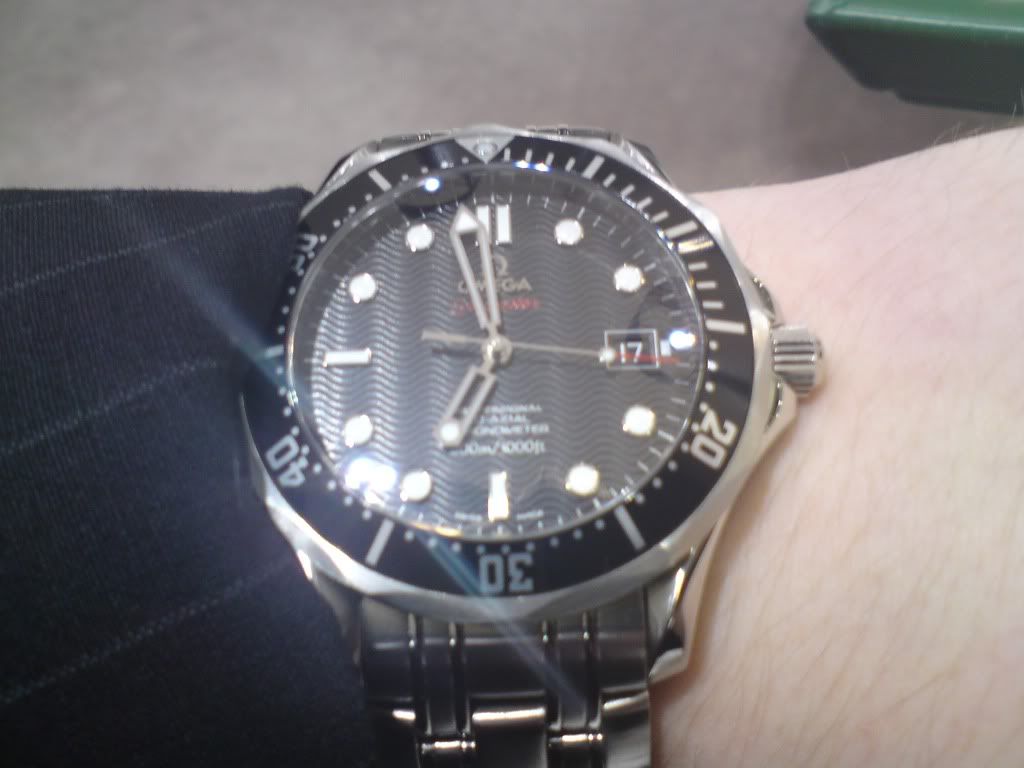
On a final note, if you want to get your hands on a new 16610, don't hang around - according to sources on TRF, Rolex USA has already run out of stock of them, and won't be getting any more steel Subs until the new model arrives. I don't know for certain whether this will be the case in the UK - as far as I'm aware, Rolex UK still has supplies in stock.
Thanks for reading
The GMT Master
Sunday, 2 August 2009
The Omega Aqua Terra - Omega's return to greatness?
If there's one watch that's really set my heart racing recently, it's the new Omega Seamaster Aqua Terra. Launched earlier this year, it's quality and looks are simply stunning, and in terms of value for money...well, I'll come back to that later.
Firstly a bit of eye candy for you all:

The Aesthetics
The Aqua Terra, in its basic format, comes in steel, steel and 18Ct Gold, and full 18Ct Gold. You have a choice of two dials in the steel model, either silver or dark grey with a tapestry-esque texturing, triangular luminous markers and arabics around the edge of the dial. There's a modern looking date aperture at 3 o'clock, and overall, the design concept is clearly modern with a definite 1950s' influence. Like any good watch, the dial is simple and uncluttered, the hands easy to read, and has a unique look that can't exactly be found on any other significant watch on the market at this time. The bracelet is solid and feels comfortable, and the clasp is a standard Omega double folding affair - not the best clasp I've seen on a watch, but it gets the job done. Inside the mid and full sized models is the truly brilliant cal. 8500.

The Movement
This is quite simply the best finished movement I've ever seen on a watch at this end of the market, and is truly a piece of art. It really is a centrepiece, and is shown off beautifully through the Sapphire display back.
The technical details:
25.2k bph
Co-Axial Escapement
60 hour power reserve
Chronometer rated
Omega's free sprung balance
Rhodium plated
Fully made in-house
In other words, a really nice piece of kit.
The Competition
Taking the mid-sized 38.5mm steel model for our baseline, the big competition comes from the Rolex Datejust 116200. In terms of looks, they are incredibly similar - the cases aren't all that different, the bracelet links are virtually the same, they're around the same size, and they both have chronometer rated self-winding movements. Whilst I'd argue that the Rolex's polished centre links make it look more dressy, I honestly think that the cal. 8500 has the potential to be better than the Datejust's cal. 3135. The cal. 8500 has been designed from the ground up (unlike past attempts to integrate the Co-Axial escapement into their range), so the reliability problems that plagued the previous Aqua Terra should have been solved. I think aesthetically it's a big selling point - it's proudly on show for the world to see, and Omega have every right to show it off. Rolex's movements have never been pretty, with them preferring to concentrate on function over form, so I doubt a factory option of a crystal caseback will be coming to the Oyster range any time soon.
Rolex once again has the edge when it comes to versatility: whilst Omega offers three different sizes (lady's, mid size, full size)in the different metal combinations, so does Rolex, with the added versatility of a huge range of dials, different bezels and different bracelets. This ability to customise your watch has always been the real appeal of the Datejust, and was one of the reasons why I chose mine. With Omega, you get the choice of a light dial, or a dark dial, take it or leave it.
However, the steel Aqua Terra is priced at a very reasonable £2600, whilst the Rolex weighs in at £3300 for its basic 116200 model. £700 is a big, big difference at this level of the market, and I'd reckon that the Omega will have a better scope for discount as well.
The Conclusion
The new Aqua Terra is certainly an excellent choice for someone who wants a simple and practical luxury watch that looks great, and is still good value for money. Whilst it may lack the range of individuality a Datejust can provide, it still is a massive step forward for Omega in their desire to return to greatness. This closes the gap closer still between the two rivals, that cal. 8500 is something that should have Rolex quaking in their boots.
My recommendation: the mid-size steel model /w black dial, reference 231.10.39.21.06.001
Thanks for reading
The GMT Master
Firstly a bit of eye candy for you all:

The Aesthetics
The Aqua Terra, in its basic format, comes in steel, steel and 18Ct Gold, and full 18Ct Gold. You have a choice of two dials in the steel model, either silver or dark grey with a tapestry-esque texturing, triangular luminous markers and arabics around the edge of the dial. There's a modern looking date aperture at 3 o'clock, and overall, the design concept is clearly modern with a definite 1950s' influence. Like any good watch, the dial is simple and uncluttered, the hands easy to read, and has a unique look that can't exactly be found on any other significant watch on the market at this time. The bracelet is solid and feels comfortable, and the clasp is a standard Omega double folding affair - not the best clasp I've seen on a watch, but it gets the job done. Inside the mid and full sized models is the truly brilliant cal. 8500.

The Movement
This is quite simply the best finished movement I've ever seen on a watch at this end of the market, and is truly a piece of art. It really is a centrepiece, and is shown off beautifully through the Sapphire display back.
The technical details:
25.2k bph
Co-Axial Escapement
60 hour power reserve
Chronometer rated
Omega's free sprung balance
Rhodium plated
Fully made in-house
In other words, a really nice piece of kit.
The Competition
Taking the mid-sized 38.5mm steel model for our baseline, the big competition comes from the Rolex Datejust 116200. In terms of looks, they are incredibly similar - the cases aren't all that different, the bracelet links are virtually the same, they're around the same size, and they both have chronometer rated self-winding movements. Whilst I'd argue that the Rolex's polished centre links make it look more dressy, I honestly think that the cal. 8500 has the potential to be better than the Datejust's cal. 3135. The cal. 8500 has been designed from the ground up (unlike past attempts to integrate the Co-Axial escapement into their range), so the reliability problems that plagued the previous Aqua Terra should have been solved. I think aesthetically it's a big selling point - it's proudly on show for the world to see, and Omega have every right to show it off. Rolex's movements have never been pretty, with them preferring to concentrate on function over form, so I doubt a factory option of a crystal caseback will be coming to the Oyster range any time soon.
Rolex once again has the edge when it comes to versatility: whilst Omega offers three different sizes (lady's, mid size, full size)in the different metal combinations, so does Rolex, with the added versatility of a huge range of dials, different bezels and different bracelets. This ability to customise your watch has always been the real appeal of the Datejust, and was one of the reasons why I chose mine. With Omega, you get the choice of a light dial, or a dark dial, take it or leave it.
However, the steel Aqua Terra is priced at a very reasonable £2600, whilst the Rolex weighs in at £3300 for its basic 116200 model. £700 is a big, big difference at this level of the market, and I'd reckon that the Omega will have a better scope for discount as well.
The Conclusion
The new Aqua Terra is certainly an excellent choice for someone who wants a simple and practical luxury watch that looks great, and is still good value for money. Whilst it may lack the range of individuality a Datejust can provide, it still is a massive step forward for Omega in their desire to return to greatness. This closes the gap closer still between the two rivals, that cal. 8500 is something that should have Rolex quaking in their boots.
My recommendation: the mid-size steel model /w black dial, reference 231.10.39.21.06.001
Thanks for reading
The GMT Master
Monday, 20 July 2009
Rolex Daytona: Worth It?
One watch that is always holds a deal of aura about it is the Rolex Daytona, and not a week goes by at the shop where I'm not asked about it. So, for the uninitiated, I'll take a few moments to explain what it is, and why it's so revered in the watch world.
The current Daytona comes in three basic forms: in stainless steel, in steel and 18Ct yellow gold and 18Ct gold (yellow, white and rose). It's a chronograph watch (a watch with a stopwatch function), comes on either the Oyster bracelet or a leather strap (only on the 18Ct models), and is quite a good looking watch by anyone's standards. The steel model starts at £6170, the two tone at just under the £9000 mark, the 18Ct models go for £19000, and if you want added diamonds and the like, the price keeps going up and up. However, the steel one is the one I'm going to focus on, as it is this one that is the Daytona.
The steel Daytona, ref. 116520, has a reputation as one of the hardest watches to buy new in the world. It's not due to the cost, but rather the huge waiting lists. I'm currently 40th on the waiting list at the shop, and at the current rate of Daytonas coming into stock, I have another 9 years to wait. Wherever you go in the UK, you'll get told there's a huge waiting list, and I don't know how many people I've seen walk out dejected when I tell them this. For the casual observer, there's nothing too fancy about it: it has an excellent movement inside it (the cal. 4130), but doesn't have features that you can't find on any other number of luxury watches. I can appreciate that the hype is a little bewildering, but I now have to put on my historian's hat to explain it all for you.
Let's cut back to the 1960s - insert whatever nostalgic recollections or conceptions you have here - and find a watch. The one we're after is the original Daytona, the ref. 6241 in particular.

If we were to ask the manager of the Rolex dealership how well this Daytona was selling, he's probably respond that it was a complete dead weight. Zero popularity, and highly unloved. Now we need to fast forward to Italy in the 1980s, which is where Daytona-mania really took off. All it needed was to be featured on the front page of an Italian fashion magazine to spark a rush to snap up this watch, especially that with the fabled "Paul Newman" exotic dial, as shown in the above picture. The desire for the Daytona spread around the world, with vintage pieces commanding huge prices at auction, and current models flying out of dealerships like proverbial hot cakes. The Daytona had become an icon.
Prices today, even with the recent financial crisis, still remain high - not so long ago, a 6241 sold at auction for a staggering Aus$80000. Let me remind you that this was for a 40 year old, steel manual wind chronograph, with a notoriously dodgy bracelet. Don't get me wrong, it's a lovely looking watch, but it's silly money for what it is. It doesn't even have an in-house Rolex movement, it uses a Valjoux 72 movement instead.
So let me get back to the current model: whilst it's difficult to get hold of brand new, it'll never be a collector's piece - it is, these days, a relatively common watch. You don't have to look too hard to find someone wearing one - Sir Alan Sugar, numerous football players, your run of the mill businessman, they'll have one strapped to their wrist. I think the thrill of getting a Daytona is trying to track one down - although I'm on the list for one, I'm not even sure if I want one any more. I think Rolex have better watches in their line up for less than the £6170 asking price of the Daytona, and I'd definitely want to look at those before a Daytona.
Then we have the prickly problem of the Daytona's biggest rival (at least in my eyes): The Omega Speedmaster Professional. There are plenty of similarities between the two: both launched at around the same time (the Speedy in 1957, the Daytona a couple of years after), both used manual wind movements, even aesthetically they were quite similar.

What's so special about this watch? The Speedmaster is the first and only watch worn on the moon, as well as the only watch that was NASA flight certified. When NASA were testing several chronographs for the Apollo programme, the Speedmaster was the only one that could withstand every single test thrown at it, beating several other chronographs, including the Rolex Daytona. Whilst vintage pieces do fetch handsome prices these days, the current model (pretty much the same watch as you could buy 40 years ago, albeit with a different manual wind movement and a much improved bracelet) is nowhere near as popular as the Daytona. It's a quarter of the price of a Daytona as well: you can walk away with a brand new Speedy Pro for £2090 retail, plus a little bit of discount too.
So, to get back to my original question, is the Rolex Daytona worth it? Well, for many it has a glittering alure, and I can see where they come from. I just personally think there are watches with more interesting backgrounds that can be had for a lot lot less, without the wait. If you buy a Daytona, you'll be getting a great watch in it's own right, but I often feel that the hype is a little unjustified.
The current Daytona comes in three basic forms: in stainless steel, in steel and 18Ct yellow gold and 18Ct gold (yellow, white and rose). It's a chronograph watch (a watch with a stopwatch function), comes on either the Oyster bracelet or a leather strap (only on the 18Ct models), and is quite a good looking watch by anyone's standards.
 The steel model starts at £6170, the two tone at just under the £9000 mark, the 18Ct models go for £19000, and if you want added diamonds and the like, the price keeps going up and up. However, the steel one is the one I'm going to focus on, as it is this one that is the Daytona.
The steel Daytona, ref. 116520, has a reputation as one of the hardest watches to buy new in the world. It's not due to the cost, but rather the huge waiting lists. I'm currently 40th on the waiting list at the shop, and at the current rate of Daytonas coming into stock, I have another 9 years to wait. Wherever you go in the UK, you'll get told there's a huge waiting list, and I don't know how many people I've seen walk out dejected when I tell them this. For the casual observer, there's nothing too fancy about it: it has an excellent movement inside it (the cal. 4130), but doesn't have features that you can't find on any other number of luxury watches. I can appreciate that the hype is a little bewildering, but I now have to put on my historian's hat to explain it all for you.
Let's cut back to the 1960s - insert whatever nostalgic recollections or conceptions you have here - and find a watch. The one we're after is the original Daytona, the ref. 6241 in particular.
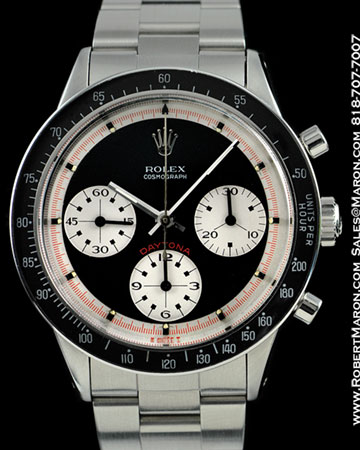
If we were to ask the manager of the Rolex dealership how well this Daytona was selling, he's probably respond that it was a complete dead weight. Zero popularity, and highly unloved. Now we need to fast forward to Italy in the 1980s, which is where Daytona-mania really took off. All it needed was to be featured on the front page of an Italian fashion magazine to spark a rush to snap up this watch, especially that with the fabled "Paul Newman" exotic dial, as shown in the above picture. The desire for the Daytona spread around the world, with vintage pieces commanding huge prices at auction, and current models flying out of dealerships like proverbial hot cakes. The Daytona had become an icon.
Prices today, even with the recent financial crisis, still remain high - not so long ago, a 6241 sold at auction for a staggering Aus$80000. Let me remind you that this was for a 40 year old, steel manual wind chronograph, with a notoriously dodgy bracelet. Don't get me wrong, it's a lovely looking watch, but it's silly money for what it is. It doesn't even have an in-house Rolex movement, it uses a Valjoux 72 movement instead.
So let me get back to the current model: whilst it's difficult to get hold of brand new, it'll never be a collector's piece - it is, these days, a relatively common watch. You don't have to look too hard to find someone wearing one - Sir Alan Sugar, numerous football players, your run of the mill businessman, they'll have one strapped to their wrist. I think the thrill of getting a Daytona is trying to track one down - although I'm on the list for one, I'm not even sure if I want one any more. I think Rolex have better watches in their line up for less than the £6170 asking price of the Daytona, and I'd definitely want to look at those before a Daytona.
Then we have the prickly problem of the Daytona's biggest rival (at least in my eyes): The Omega Speedmaster Professional. There are plenty of similarities between the two: both launched at around the same time (the Speedy in 1957, the Daytona a couple of years after), both used manual wind movements, even aesthetically they were quite similar.

What's so special about this watch? The Speedmaster is the first and only watch worn on the moon, as well as the only watch that was NASA flight certified. When NASA were testing several chronographs for the Apollo programme, the Speedmaster was the only one that could withstand every single test thrown at it, beating several other chronographs, including the Rolex Daytona. Whilst vintage pieces do fetch handsome prices these days, the current model (pretty much the same watch as you could buy 40 years ago, albeit with a different manual wind movement and a much improved bracelet) is nowhere near as popular as the Daytona. It's a quarter of the price of a Daytona as well: you can walk away with a brand new Speedy Pro for £2090 retail, plus a little bit of discount too.
So, to get back to my original question, is the Rolex Daytona worth it? Well, for many it has a glittering alure, and I can see where they come from. I just personally think there are watches with more interesting backgrounds that can be had for a lot lot less, without the wait. If you buy a Daytona, you'll be getting a great watch in it's own right, but I often feel that the hype is a little unjustified.
Subscribe to:
Posts (Atom)
